Showing posts with label 30DaysWild. Show all posts

Saturday, 18 June 2016

Saw the First Wild Rose in Bloom

In the June 15 entry for her 1906 journal, Edith Holden wrote:

It is very pretty to see the House Martins sitting in the roadway, collecting mud for their nests. Their short feathered legs look as if they had little white socks on.

I was quite surprised to come upon a bank of beautiful purple Fox-gloves today, - fully out. These are the first I have seen in flower.

On my journey to Birmingham on Tuesday the 14th of June 2016, I had made a point of noticing the wild flowers on the road side and railway embankments as noted on my Uckfield, Sussex blog.  The Virgin Pendelino had outrun the rain and cloud and, on my walk to the office, I was treated to glimpses of sunshine between heavy clouds.

House Martins under a heavy sky - June 14th.
Above my head a group of House Martins treated me to the most tremendous aerial ballet.  Over the next two days I checked the nests on the outside of the Arden hotel a few times but there was no signs that the birds were attending them. That said, the weather was so foul that I didn't stay out for very long. Last year I saw them taking an interest in the nests from 3rd June.  I discovered them because I had been checking out wildlife near the hotel as part of the Wildlife Trust's #30DaysWild challenge, which I am repeating this year.

After work, the weather outlook was very uncertain so, having got rid of my laptop, I explored a piece of waste ground close the hotel.

Hemlock - pretty but deadly.
Between hotel's carpark and one of the offices there is a stand of intriguing wild flowers. They looked very much like Cow Parsley but were much taller and had blotched stems.  This is Hemlock, which has been deadly to ancient philosophers and children, who made peashooters from the stems, alike.

Elder flower on the edge of the hotel carpark.
As I left the hotel grounds, I found some Green Alkanet, which was providing a free buffet for Common Carder and Early Bumble Bees. There was one, rather feeble looking Foxglove and an Elderflower bush catching the last of the summer rays.

Wild roses and office buildings.
I had also noticed wild Dog Roses blooming. They had just started on my previous visit, two weeks before, suggesting that they are a little ahead of those that Edith described on June the 16th, 110 years ago. 

Saw the first Wild Rose in bloom, - a fine pink one, on the top of a high hedge; also Blackberry in blossom. The Roses and Honeysuckle are full of bud, but they are late in bloom this year, owing to the long spell of cold weather.

Red-tailed Bumble Bee on Weld.
A common plant on the business park is Weld, which used to be used for making dye.  Here a Red-Tailed Bumble Bee was greedily feeding on the blooms.

Marmalade Hoverfly on stinging nettle.
Following the road round, clumps of nettles provided resting places for hoverflies and 7-Spot Ladybirds.  As I investigated the insects and flowers I heard a loud chatter - a family of at least five Magpies was jumping in-and-out of the bushes. A nearby Rabbit looked unimpressed with their antics. As I looked up at Pine cones in a tree, I saw a charm of Goldfinches fly towards the hotel. As the sky was darkening, I followed them.

Sheltering from the rain - June 14th.
As I was passing the apparently empty House Martin nests on the side of the hotel, the heavens opened. I stood under a tree for a bit, finding the sound of the rain around me peaceful - but was mindful that there had been problems with flooding in Birmingham and that this meant worse was to come.

Wednesday, 8 June 2016

Ragged Robin on a Ragged Verge

Edith Holden's diary for early June 1906 described several trips in which she gathered wild flowers. For June the 8th she says:

Cycled through Widney, I gathered Lesser Spearwort in the marsh there, also Ragged Robin.

Her watercolours show a multitude of wildflowers including ox-eye daisies, clover and guilder rose.

Day 1 - Roadside flowers

For the first day of the Wildlife Trusts' #30DaysWild challenge I wanted to see if I could find some of Edith's flowers. So on a rather dull Wednesday morning, before I went into work, I set out to find wild flowers on the verge alongside the road leading from Birmingham International Station to Trinity Park.  Because light levels were low, it was mostly the white flowers that caught my attention.

White deadnettle.
Guelder Rose.
I was intrigued to find that some flowers, such as daisies, were closed up, waiting for the light. Other, less delicate blooms such as the Guelder Rose were already open.

Self-heal.
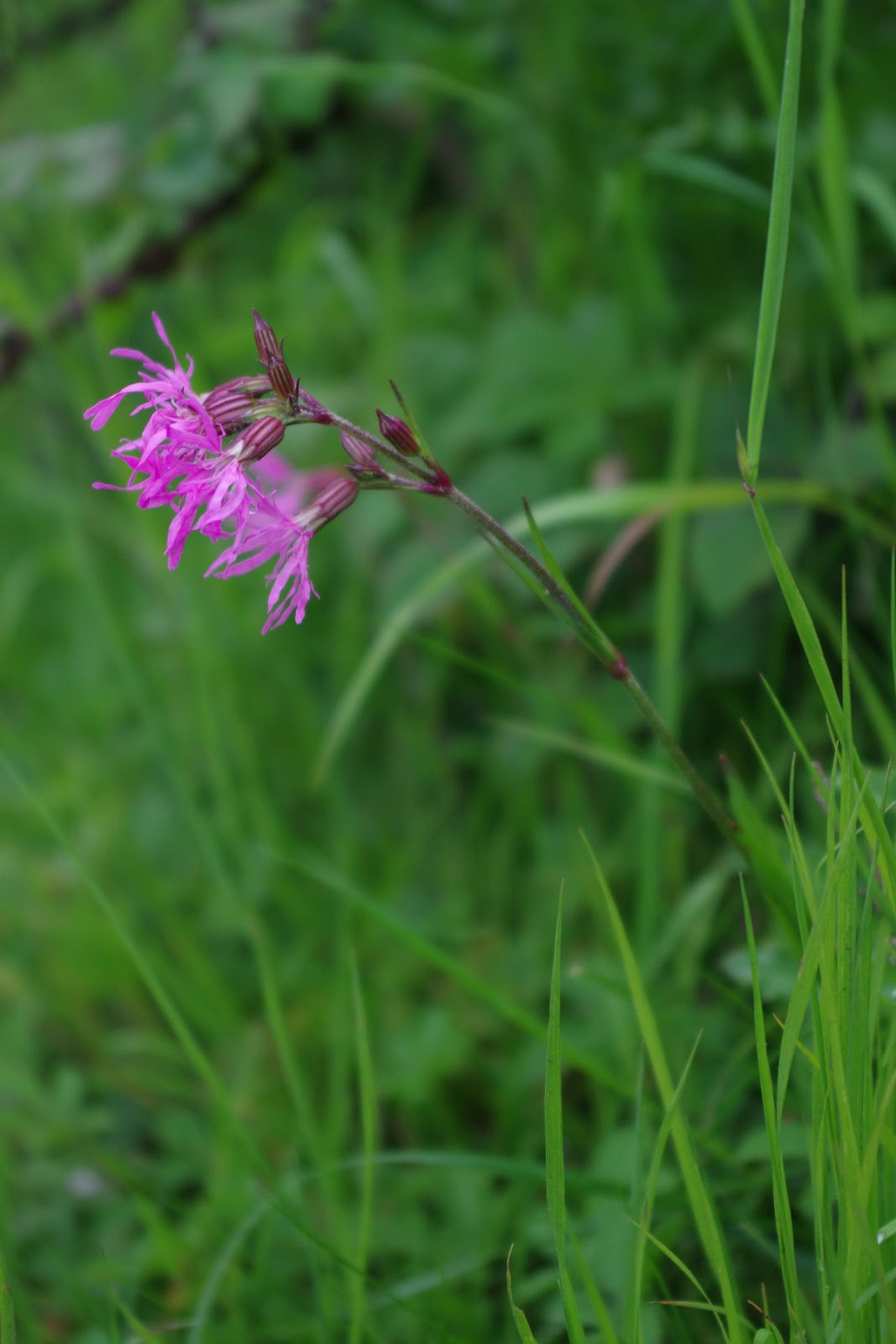
Ragged Robin
My world and Edith's suddenly and surprisingly connected when I found the delicate, pink Ragged Robin in this ragged roadside verge.

The last of the hawthorn blossom.
Later in the day, when my colleagues and I set off to get lunch at the Airport, we noticed a commotion in one of the confers on the business park. A flurry of black-and-white feathers betrayed the presence of magpies - but what was the bulky looking brown bird that left the tree? I circled round and spotted a Mistle Thrush.

Later in the day I visited the Elmdon Nature Park, where I found the field Golden with Buttercups.

Day 2 - Visit to a pond

For Day 2 of #30DaysWild, I sketched the pond near our office before starting work.

Watercolour sketch of the Trinity Park pond.
While I was there I saw the two pairs of tufted ducks that I saw a fortnight ago.
Azure Damselfly male
At lunchtime I took another look and found:
  • the two pairs of Tufted Ducks
  • Coots
  • three well-grown Mallard ducklings, hiding in the reeds
  • and a lot of squeaking from the reedbed, maybe the young Moorhens that I saw a fortnight ago.
Having lingered by the pond, I started to walk round it, briskly, and walked straight into a Damselfly. I saw two males and one female on a sunlit bush. I identified them with the help of the British Damselfly Society Identification page.

Saturday, 28 May 2016

God's Acre, Hampton-in-Arden

In her 1906 diary, Edith mentions going on long walks and cycle rides through places like Hampton-In-Arden.  My snatched hours in Birmingham don't allow for long country walks but Hampton-in-Arden is only a few minutes down the railway line from Birmingham International.
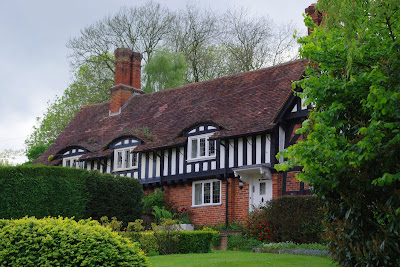
Old house between Hampton-in-Arden station and village.
Although the village has modern estates on the outskirts and the road connecting it with the station is very busy, there are still clear echoes of the village that Edith walked through in 1906.  Along the road, I see several of the fine old houses and cottages that Edith must have seen as she travelled through.

Saint Mary and Saint Bartholomew Church.
The road curls round the Parish Church of Saint Mary and Saint Bartholomew. This 800-year church is surrounded by a fine example of "God's Acre", alive with wildflowers, bees and birds.
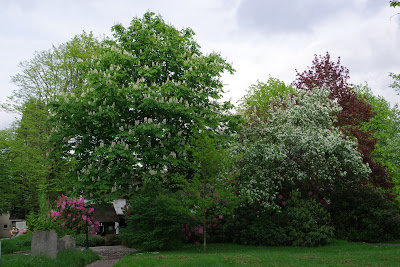
Trees on the edge of the church yard.
The church and graveyard are framed by pretty, flowering trees.
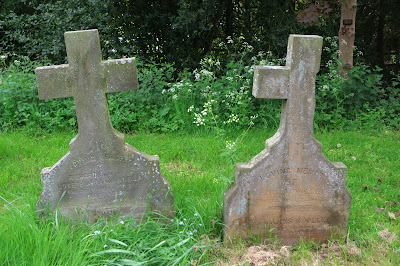

In Loving Memory.
Some of the older, Victorian, gravestones are a curious shape. This must be some local pattern - I have not seen anything like them elsewhere.  Two commemorate members of the Wooley family. Nearby the grass is neatly clipped but near the boundary a froth of cow parsley provides a fine buffet for bees and other pollinators. A red-tailed bumble bee buzzes near by feet as she forages for her last meal of the day.
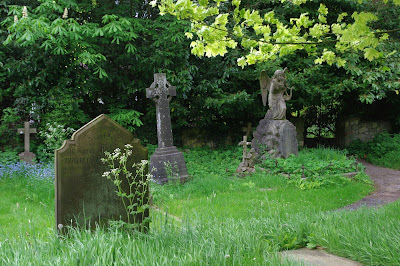
Thomas Whitehouse's last bouquet.
A Cow Parsley plant adorns Thomas Whitehouse's grave, long after the family members who would have left flowers have joined him in the hereafter. 
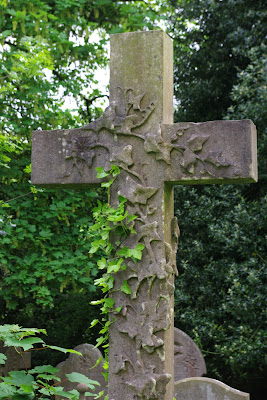
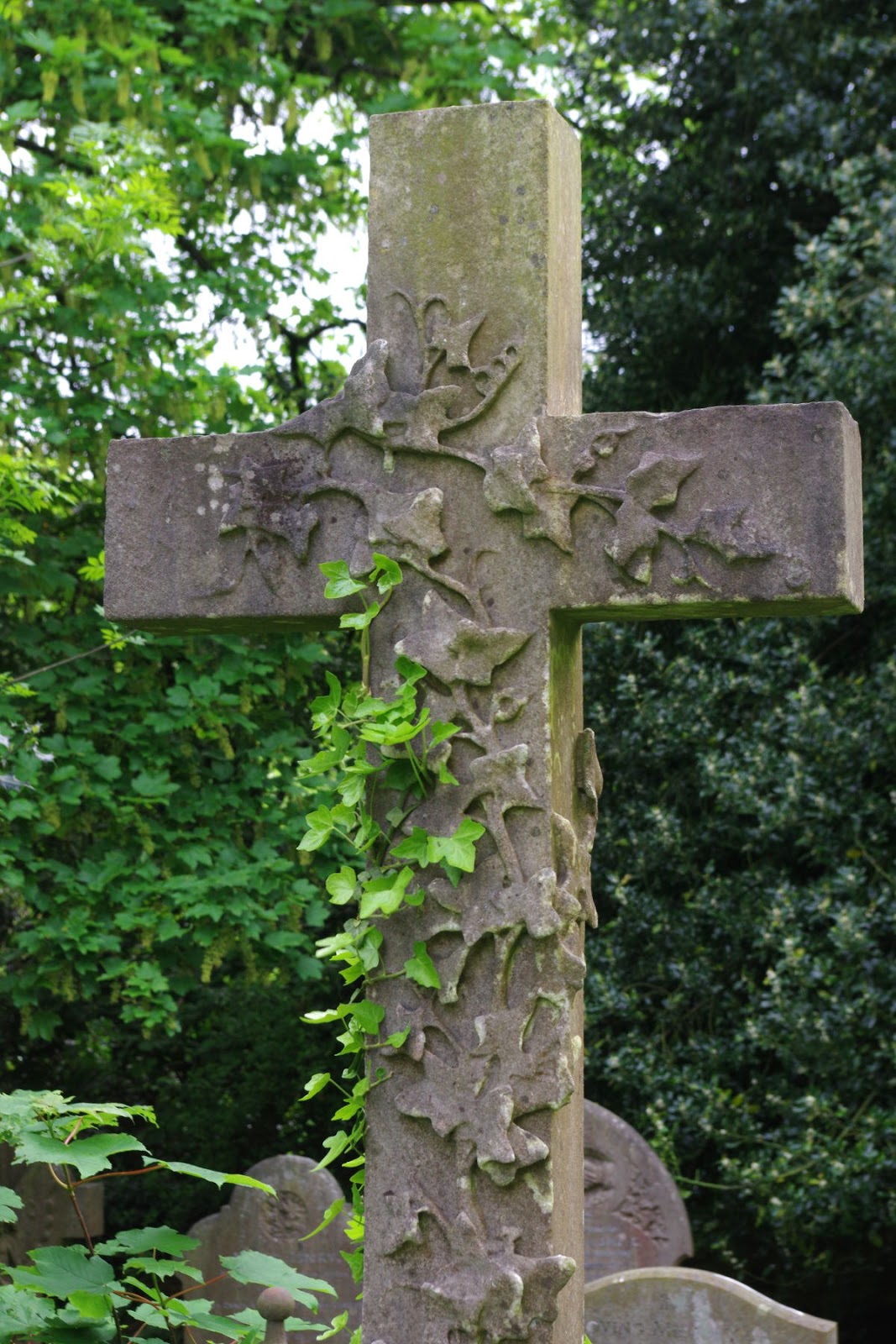
Real and carved ivy.
On a nearby cross, real ivy mingles with the carved stone imitation.
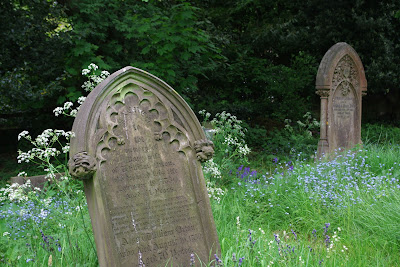
Gravestones amongst Forget-me-nots and Cow Parsley
Making my way past an ancient yew, I found a quiet corner, where leaning gravestones were surrounded by cow parsley, forget-me-nots and fading bluebells.

Flowering trees on the way to the lych gate.
As I returned to the lych gate, a cheeky robin perches on the apex of Sarah and Abraham Taylor's headstone.

The White Lion.
After exploring God's Acre, I had an excellent meal at the White Lion.
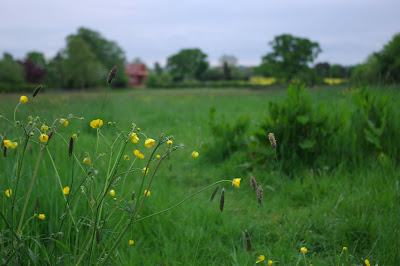
Buttercups
After my meal, light was fading fast so I took a quick walk round the village, which is full of interest. My favourite spot was a buttercup meadow, with a serene view to the fields. As I took my photos, I could hear sheep and lambs in the distance. 
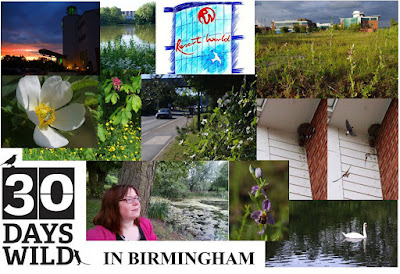
30 Days Wild
I am just about to start the Wildlife Trusts' 30 days wild, a challenge in which people do something wild every day for a month. Last year's 30 days wild motivated me to explore the area near where I work and stay in Birmingham and find new places to walk in such as Elmdon Park near one of the hotels I regularly stay in. Finding out that Edith Holden, who wrote Diary of an Edwardian Country lady in 1906, walked through Elmdon park 110 years before me inspired me to write this blog, in which I am aiming to find echoes of her observations in the 21st Century.

Bee orchid on a piece of waste ground.
30 Days Wild got me into the habit of being more opportunistic about engineering encounters with the wildlife that tucks itself into the spaces around us. My most memorable encounters were watching grey wagtails and house martins raise their families. They weren't in a nature reserve or even the countryside but in sight of Uckfield station and under the eves of a Birmingham hotel respectively. I even found some bee orchids on a piece of waste ground near our office.