Friday, 26 August 2016

Scarlet berries

In her entry for the 4th of August, 1908, Edith noted "Harvesting Commenced". This also marked the start of the long school holidays. In those days, the pupils needed this time as the whole family was expected to help with the harvest.

Rushing past the harvest, 26 July 2016,
110 years later, harvesting is very different. Sophisticated combine harvesters do the work of many weary hands. Even the bales look different. My photo, snatched from a speeding train, shows the modern round bales. Over the last few years these have been replacing the blocks familiar from my childhood. When researching this post, I was almost shocked to find that, when I first saw these blocks in the 1960s, that they were new, having been produced by the earliest combine harvesters. Earlier grain crops and hay would have been harvested as bundles, which would have been piled into stooks.


Resorts World.
At the end of July, a colleague and I walked over to the NEC to see the new Star Trek Beyond movie. As we approached Pendigo Lake I heard the plaintive cry of a young Great Crested Grebe. It was soon fed by it's attentive parent. I spent a while watching the birds on the lake and then headed towards Resorts World.

Young Coot, 26 July 2016
On the way, I found a family of coots grazing on the Crowne Plaza's grass. This youngster was very curious about me. Some hours later, after shopping, movie and food, night had fallen and the lake was dark. However lights from the hotels highlighted white feathers on birds, which had stayed on the lake. We were able to pick out the family of Canada Geese that I had seen on a previous visit and four male tufted ducks. The latter presumably included the fathers of the ducklings I saw on the pond next to the office.


Rowen Berries, 27 July 2016
In a couple of her entries for August, Edith mentions "scarlet berries". At the end of July the only scarlet berries I found were some Rowen berries in the car park of the Arden hotel.  Other tree seeds I found nearby included the following.

Lime tree seeds with 'wings', 26 July 2016.

Field Maple 'aeroplanes', 27 July 2016
Winged hornbeam seed, 27 July 2016
sloe berries, 27 July 2016

Saturday, 13 August 2016

Elmdon Park - Walled Park Nature Reserve

As I am no longer working in Birmingham, I will plunder last year's photos to continue my journal.

St Nicholas - 28 July 2015
In 1908 Edith mentioned three visits to Elmdon Park in May, June and October. 109 years later, I visited Elmdon too. After work, I checked into the Holiday Inn, dumped my luggage and walked briskly through the Nature Park that I visited in June this year and past St Nicholas.  According to William Dargue's page on Elmdon, the church that I saw was built in 1781, replacing the dilapidated one that previously stood on the site. It was rebuilt by Abraham Spooner, the owner of the long since demolished Elmdon Hall.

Old walls - 28 July 2015
My aim was to visit Elmdon Hall's old walled garden, which forms part of the Warwickshire Wildlife Trust's Elmdon Manor nature reserve. Dargue's page on Elmdon tells us that "Measuring a hectare in area, the walled garden was reputedly in its day the largest in the country. Some of the walls and the ruins of greenhouses survive." Just before I reached the wall, there was a tangle of wild plants including delicious wild raspberries.


Ferns and mosses on brickwork - 28 July 2015 

Yellow loosestrife - 28 July 2016
In Edith's time, it's likely that the garden would have been immaculately kept and extremely productive. As I followed the footsteps of long-dead gardeners, I found ferns growing out of the steps and a mixture of wild and garden plants spilling over the paths.
Apples - 28 July 2015
Someone has clearly been hard at work here. There are fairly young fruit trees to remind us of the garden's former purpose, which was to produce fruit and vegetables for the big house. 

Campanula - 28 July 2015
According to the SEAG community blog:

The head and under gardeners had cottages close by at Elmdon Farm with as many as 20 men and boys working in the kitchen and pleasure gardens. The walled garden was intersected by wide grass paths with neat box hedges, and after the removal of the glass tax in 1845, extensive greenhouses and cold frames. Around the walls espalier and fan shaped apple trees with the more tender fruits such as nectarines and apricots occupying the south facing walls.

Sadly many of the gardeners who would have been tending the gardens in 1908 are likely to have left Elmdon for the First World War. Also the house changed hands a number of times and went into decline. Now long grass and wildflowers catch the low evening sun and provide a feast for insects and other wildlife.

Airport buildings seen over crops - 28 July 2015
Having explored the garden, I looked round the rest of the nature reserve. There is a lake and trees including old Yews.  Intrigued by glimpses of gold, I peered out from between the trees. I was greeted by the rather surreal sight of airport buildings and hotels beyond ripening crops. The golden evening sun had been replaced by sulky clouds.

Holiday Inn Hotel with rainbow - 28 July 2015
As I walked back to the hotel, the inevitable drizzle started. As I got back to the hotel, the sun came out again and I captured a rainbow.

Saturday, 30 July 2016

Butterflies flying hither and thither

In her entry for 21st of July 1906, Edit talks about seeing butterflies "flying hither and thither". Her butterflies were Meadow Browns, attracted by blossom in a Privet hedge. Mid-afternoon on July 26th, 110 years later, I was scurrying between the office and hotel when I noticed 3 Large Whites apparently attracted by the Buddleia on a vacant lot between offices. They were not obliging enough to settle, so here is one from my Sussex garden.

Large White butterfly from my Sussex garden.
This butterfly seems to be very abundant this year. I have been doing the Big Butterfly Count, in which people all over the country record the species and numbers of butterflies that they see.  In previous years, Gatekeepers and Meadow Browns have dominated my lists but this year the Large Whites are way ahead of the others.
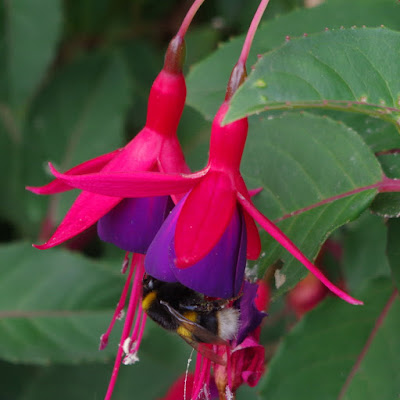
July 27 - White tailed bumble bee on Fuchsia.
After work the next day, I took a walk along the side of the busy A45 Coventry Road to see what flowers and wildlife I could find.  Before I left the hotel grounds, I found a bumble bee on a colourful fuchsia.
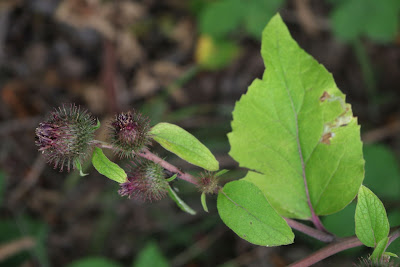
July 27 - Burdock.
In the shadow of the hotel wall, I found a burdock.  After this, between the hotel and the railway line there is a 'waste' area surrounded by Buddleia. True to its other name of "butterfly bush" it was attracting the last few butterflies of the day - a couple of whites and a bright Red Admiral, which disappeared into the bushes.

July 27 - Blue Fleabane.
At ground level, there were slender plants, so delicate and inconspicuous, that I hardly saw them to start with. They are Blue Flea-bane.  A little further up, on the NEC boundary, Field Maple and other trees soar into the air. As I looked up, one of the white butterflies settled in the leaves. Maybe that was its refuge for the night. 

July 27 - Wild Carrot by the A45.
Further stil, the verge between the footpath and the road widens, creating a haven for wildflowers, particularly Wild Carrot and Pink Campion.

July 27 - Tree Bumble Bee on Bramble.
Although the butterflies were hiding away for the night there were still plenty of bees around.
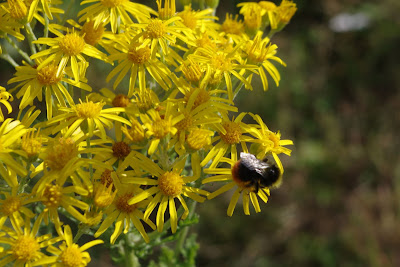
July 27 - Red-tailed Bumble Bee.
After reaching the roundabout which leads to the NEC, I retraced my footsteps, and went back to the vacant lot at Trinity Park.  Here I found bees busy on the bright yellow Ragwort. 
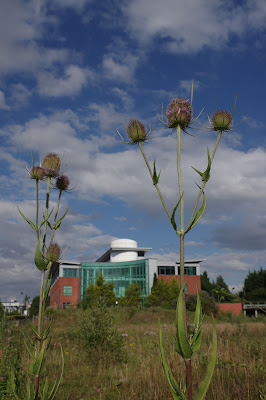
July 27 - Teasels.
I was photographing the fine, tall teasels, when a family passed on their way to the hotel. The little girl was more curious than the others and looked in the direction I was photographing. She was thrilled to see a rabbit. With that pleasant encounter, I returned to the bar and joined my colleagues for drinks and a meal.

Saturday, 23 July 2016

Babies in the Bulrushes

In mid July, Edith talked about various water plants. Over the last month I've particularly noticed the growing catkins of Bulrushes (also called reedmace).

Tufted ducks and bulrushes, July 20th
Once again, I visited the pond at Trinity Park and watched the waterfowl. The bulrushes make a fine hiding place for baby birds. This time, I could hear rustlings as young ducks and coots (I think) moved around the reedbed.  On the pond itself I saw:
  • Two families of Tufted Ducks, each headed by a lone female. The young a somewhat bigger than he last time I saw them but still fuzzy and babyish. The numbers are reduced - there was one family with 6 babies and one with four.  The babies keep bobbing down in the water and up again.
  • Two adult Moorhens and one youngster.
  • One adult Mallard.
  • One adult Coot.
Moses in the 'Bulrushes'.
I'd better get this out of the way now. In my head, I always call them Bulrushes although I'm told that they are really Reedmace (Typha latifolia). Many people say that the confusion is down to the picture above. When I attended Sunday School, nearly half-a-century ago, we read from an illustrated book of bible stories. Looking at the Moses in the Bullrushes picture reminds me of childhood Sunday mornings. We gathered round trestle tables in the 1950's built Christ Church, Hayes. Middlesex. We read stories, drew pictures and did other church-related things. One of the stories we read was about Pharaoh's daughter finding Moses in the Nile. The King James version of the bible says:

And Pharaoh charged all his people, saying, Every son that is born ye shall cast into the river, and every daughter ye shall save alive.

It goes on to explain that Moses' mother managed to keep him hidden until he was 3 months old.

And when she could not longer hide him, she took for him an ark of bulrushes, and daubed it with slime and with pitch, and put the child therein; and she laid it in the flags by the river's brink.
...
And the daughter of Pharaoh came down to wash herself at the river; and her maidens walked along by the river's side; and when she saw the ark among the flags, she sent her maid to fetch it.

According to F. Nigel Hepper's "Planting A Bible Garden", The "Flags" could have been sweet flag (Acorus calamus). So, after all this fuss about names, it was a completely different plant. Returning from the banks of the Nile in ancient Egypt to a pond in Birmingham ...

Developing catkin, June 29th.
I had never thought about the way that the Bulrush catkins grow. They were just there - like fat, brown cigars on the end of a stalk, much like the ones I saw when I first started this blog in January. Since the beginning of the year, the neat catkins have become shaggier to the point that I could see birds collecting the fluff for their nests. At the end of June, I noticed young catkins forming. They were low enough to look down on and the golden spike was just a sign of things to come.  Now, a month later, they have their adult shape but are still a golden colour, ready to ripen into those handsome dark cigars.

Saturday, 16 July 2016

Hedges were festooned with wreathes of black bryony and honeysuckle

In her entry for June the 26th, Edith described a long country walk in which ...

We picnicked under the hedge with pink and white Clover bloom and tall grasses nodding round our heads, while a pair of excited Robins chattered and fluttered in the bushes round us.

My break with others was a little less bucolic, on Wednesday the 29th we spent some time at the Arden hotel playing board games and pool, followed by a meal. I stepped out for a moment and checked the House Martin nests. I saw an adult bird coming away from one nest and heard the young within. 

June 29 - Family of Coots near Crowne Plaza.
The next morning, I saw a little family of coots just outside the Crowne Plaza hotel and saw House Martins swooping over Pendigo lake. I also saw both types of clover.
June 29 - Red Clover.

June 29 - White Clover.
In her entry for July the 7th, Edith says:

In many places the hedges were festooned with wreathes of black bryony and honeysuckle.

29 June - White Bryony near the Crowne Plaza
It took some doing but I managed to find both White Bryony and Honeysuckle in the wooded areas on the edge of Pendigo lake.  Edith goes on to say:

The pale pink Blackberry blossom and the large white masses of white Elderflower blossom are everywhere conspicuous. Climbing up the banks to meet them are tall purple foxgloves and nodding heads of grass heavy with pollen, mingled with yellow and purple vetch and clover blossom.

June 29 - Birds-Foot Trefoil.
June 29 - Ox-eye daisies.
June 29 - Elderflower.
June 29 - Foxgloves and Resort World.
I found several of these flowers around the edge of Pendigo lake. While I was photographing the foxgloves, I saw two Common Terns flying over the water.

Later in her July 7th entry, Edith says:

In a corn field of growing wheat, I saw a number of blossoms of the Opium Poppy; their large red blossoms made fine patches of colour among the green blades. 

June 29 - Opium Poppy.
Near Pendigo lake, I found Opium Poppies and other garden flowers.

In her July 11th entry, Edith tells us that she "Went by train to Knowle and walked across the fields to Packwood." and goes on to describe the flowers that she sees.

My journey from Birmingham International to Euston wasn't so picturesque but, on my way to the station, I saw some flowers on shingle heaped up beside a car park and in nearby grass.
June 30 - Common Cudweed.
June 30 - Sea Mayweed
June 30 - Self Heal.
June 30 - Scarlet pimpernel.

Friday, 8 July 2016

I found the Meadowsweet in bloom ...

In her entry for June 26th, 1906, Edith describes a long country walk. She tells us of a breeze bringing her the scent of honeysuckle and roses. She says:

"I found the Meadow Sweet in bloom in many places, Gathered Self heal and Great Burnet ..."

Meadow Sweet.
Once again, I found myself looking for Edith's flowers along the stretch of road from the station to the office. There is a great deal of Meadow Sweet, but most of it is yet to bloom.  I found a sprig to photograph.  I also found the following flowers.

June 30 - Pink centaury, knapweed and other wayside flowers.
June 30 - Willowherb.
June 28 - Hypericum
June 30 - Pink Mallow.
June 30 - Agrimony
June 30 - Spear Thistle.
Later Edith says:

"Saw a great number of beautiful little Dragon flies - pale blue, with black markings, at a wayside pond."

On Thursday, I visited the pond next to the office, As I walked round, I startled a Damselfly, much like the ones Edith saw 110 years ago. 
June 30 - Female Tufted Duck and ducklings.
I looked across the lake and saw some of the resident birds including two female Tufted Ducks with their families. Each had about 8 ducklings. The tiny, fluffing ducklings were already diving below the surface.

For June the 28th, she says: "Second day of continuous rain" and describes the earthquakes around the country. For the 3 days I was in Birmingham, there has been a series of heavy downpours. When the rain stops, the sky remains grey and heavy.

June 28 - Young Canada Geese.
On Tuesday, I had a late night wander round Pendigo Lake. Great, flickering screens were showing tennis from a washed out Wimbledon. Near the entrance to my own hotel, the Crowne Plaza, I found a family of Canada Geese. One, presumably the male, was guarding the others, which were happily grooming and resting beside a busy path.

Resorts World
I tried out my bat detector and detected at least one bat at the South end of the lake, I was able to see it against the light of Resort World.