Showing posts with label coot. Show all posts

Friday, 26 August 2016

Scarlet berries

In her entry for the 4th of August, 1908, Edith noted "Harvesting Commenced". This also marked the start of the long school holidays. In those days, the pupils needed this time as the whole family was expected to help with the harvest.

Rushing past the harvest, 26 July 2016,
110 years later, harvesting is very different. Sophisticated combine harvesters do the work of many weary hands. Even the bales look different. My photo, snatched from a speeding train, shows the modern round bales. Over the last few years these have been replacing the blocks familiar from my childhood. When researching this post, I was almost shocked to find that, when I first saw these blocks in the 1960s, that they were new, having been produced by the earliest combine harvesters. Earlier grain crops and hay would have been harvested as bundles, which would have been piled into stooks.


Resorts World.
At the end of July, a colleague and I walked over to the NEC to see the new Star Trek Beyond movie. As we approached Pendigo Lake I heard the plaintive cry of a young Great Crested Grebe. It was soon fed by it's attentive parent. I spent a while watching the birds on the lake and then headed towards Resorts World.

Young Coot, 26 July 2016
On the way, I found a family of coots grazing on the Crowne Plaza's grass. This youngster was very curious about me. Some hours later, after shopping, movie and food, night had fallen and the lake was dark. However lights from the hotels highlighted white feathers on birds, which had stayed on the lake. We were able to pick out the family of Canada Geese that I had seen on a previous visit and four male tufted ducks. The latter presumably included the fathers of the ducklings I saw on the pond next to the office.


Rowen Berries, 27 July 2016
In a couple of her entries for August, Edith mentions "scarlet berries". At the end of July the only scarlet berries I found were some Rowen berries in the car park of the Arden hotel.  Other tree seeds I found nearby included the following.

Lime tree seeds with 'wings', 26 July 2016.

Field Maple 'aeroplanes', 27 July 2016
Winged hornbeam seed, 27 July 2016
sloe berries, 27 July 2016

Saturday, 23 July 2016

Babies in the Bulrushes

In mid July, Edith talked about various water plants. Over the last month I've particularly noticed the growing catkins of Bulrushes (also called reedmace).

Tufted ducks and bulrushes, July 20th
Once again, I visited the pond at Trinity Park and watched the waterfowl. The bulrushes make a fine hiding place for baby birds. This time, I could hear rustlings as young ducks and coots (I think) moved around the reedbed.  On the pond itself I saw:
  • Two families of Tufted Ducks, each headed by a lone female. The young a somewhat bigger than he last time I saw them but still fuzzy and babyish. The numbers are reduced - there was one family with 6 babies and one with four.  The babies keep bobbing down in the water and up again.
  • Two adult Moorhens and one youngster.
  • One adult Mallard.
  • One adult Coot.
Moses in the 'Bulrushes'.
I'd better get this out of the way now. In my head, I always call them Bulrushes although I'm told that they are really Reedmace (Typha latifolia). Many people say that the confusion is down to the picture above. When I attended Sunday School, nearly half-a-century ago, we read from an illustrated book of bible stories. Looking at the Moses in the Bullrushes picture reminds me of childhood Sunday mornings. We gathered round trestle tables in the 1950's built Christ Church, Hayes. Middlesex. We read stories, drew pictures and did other church-related things. One of the stories we read was about Pharaoh's daughter finding Moses in the Nile. The King James version of the bible says:

And Pharaoh charged all his people, saying, Every son that is born ye shall cast into the river, and every daughter ye shall save alive.

It goes on to explain that Moses' mother managed to keep him hidden until he was 3 months old.

And when she could not longer hide him, she took for him an ark of bulrushes, and daubed it with slime and with pitch, and put the child therein; and she laid it in the flags by the river's brink.
...
And the daughter of Pharaoh came down to wash herself at the river; and her maidens walked along by the river's side; and when she saw the ark among the flags, she sent her maid to fetch it.

According to F. Nigel Hepper's "Planting A Bible Garden", The "Flags" could have been sweet flag (Acorus calamus). So, after all this fuss about names, it was a completely different plant. Returning from the banks of the Nile in ancient Egypt to a pond in Birmingham ...

Developing catkin, June 29th.
I had never thought about the way that the Bulrush catkins grow. They were just there - like fat, brown cigars on the end of a stalk, much like the ones I saw when I first started this blog in January. Since the beginning of the year, the neat catkins have become shaggier to the point that I could see birds collecting the fluff for their nests. At the end of June, I noticed young catkins forming. They were low enough to look down on and the golden spike was just a sign of things to come.  Now, a month later, they have their adult shape but are still a golden colour, ready to ripen into those handsome dark cigars.

Saturday, 16 July 2016

Hedges were festooned with wreathes of black bryony and honeysuckle

In her entry for June the 26th, Edith described a long country walk in which ...

We picnicked under the hedge with pink and white Clover bloom and tall grasses nodding round our heads, while a pair of excited Robins chattered and fluttered in the bushes round us.

My break with others was a little less bucolic, on Wednesday the 29th we spent some time at the Arden hotel playing board games and pool, followed by a meal. I stepped out for a moment and checked the House Martin nests. I saw an adult bird coming away from one nest and heard the young within. 

June 29 - Family of Coots near Crowne Plaza.
The next morning, I saw a little family of coots just outside the Crowne Plaza hotel and saw House Martins swooping over Pendigo lake. I also saw both types of clover.
June 29 - Red Clover.

June 29 - White Clover.
In her entry for July the 7th, Edith says:

In many places the hedges were festooned with wreathes of black bryony and honeysuckle.

29 June - White Bryony near the Crowne Plaza
It took some doing but I managed to find both White Bryony and Honeysuckle in the wooded areas on the edge of Pendigo lake.  Edith goes on to say:

The pale pink Blackberry blossom and the large white masses of white Elderflower blossom are everywhere conspicuous. Climbing up the banks to meet them are tall purple foxgloves and nodding heads of grass heavy with pollen, mingled with yellow and purple vetch and clover blossom.

June 29 - Birds-Foot Trefoil.
June 29 - Ox-eye daisies.
June 29 - Elderflower.
June 29 - Foxgloves and Resort World.
I found several of these flowers around the edge of Pendigo lake. While I was photographing the foxgloves, I saw two Common Terns flying over the water.

Later in her July 7th entry, Edith says:

In a corn field of growing wheat, I saw a number of blossoms of the Opium Poppy; their large red blossoms made fine patches of colour among the green blades. 

June 29 - Opium Poppy.
Near Pendigo lake, I found Opium Poppies and other garden flowers.

In her July 11th entry, Edith tells us that she "Went by train to Knowle and walked across the fields to Packwood." and goes on to describe the flowers that she sees.

My journey from Birmingham International to Euston wasn't so picturesque but, on my way to the station, I saw some flowers on shingle heaped up beside a car park and in nearby grass.
June 30 - Common Cudweed.
June 30 - Sea Mayweed
June 30 - Self Heal.
June 30 - Scarlet pimpernel.

Sunday, 22 May 2016

Horse-Chestnut Trees are a mass of white blossom

In her entry for May the 16th, 1906, Edith noted that:

"Some of the Horse-Chestnut trees are a mass of white blossom". 

Horse-chestnut flowers, May 15th - in the evening sun.
Horse-chestnut leaves, May 15th.
110 years later, I am staying in the Arden Hotel, which is surrounded by trees and bushes including both red and white Horse-Chestnut trees. Their scent drifts over me as I examine the strange, complicated blooms. In her diary for this time, Edith painted many tree flowers and I've paid special attention to them in this post.

Hawthorn, May 15th - late moring.
Pine flowers, May 15th.
Earlier, as I walked to work from the station, I found a variety of tree flowers including great swags of May (Hawthorn) and the odd but attractive flowers of Pine.

Male (brown) and female (green) Birch Catkins, May 19th.
Later the same day, as I was looking at the trees near the hotel, 7 House Martins flew overhead. In the car park, I found birches with catkins and briefly played hide-and-seek with vivid green but camera shy Polydrusus Weevils.

Crab apple blossom, May 15th.
Clouds of Crab Apple blossom floated above the car park as the setting sun made their delicate white petals glow.

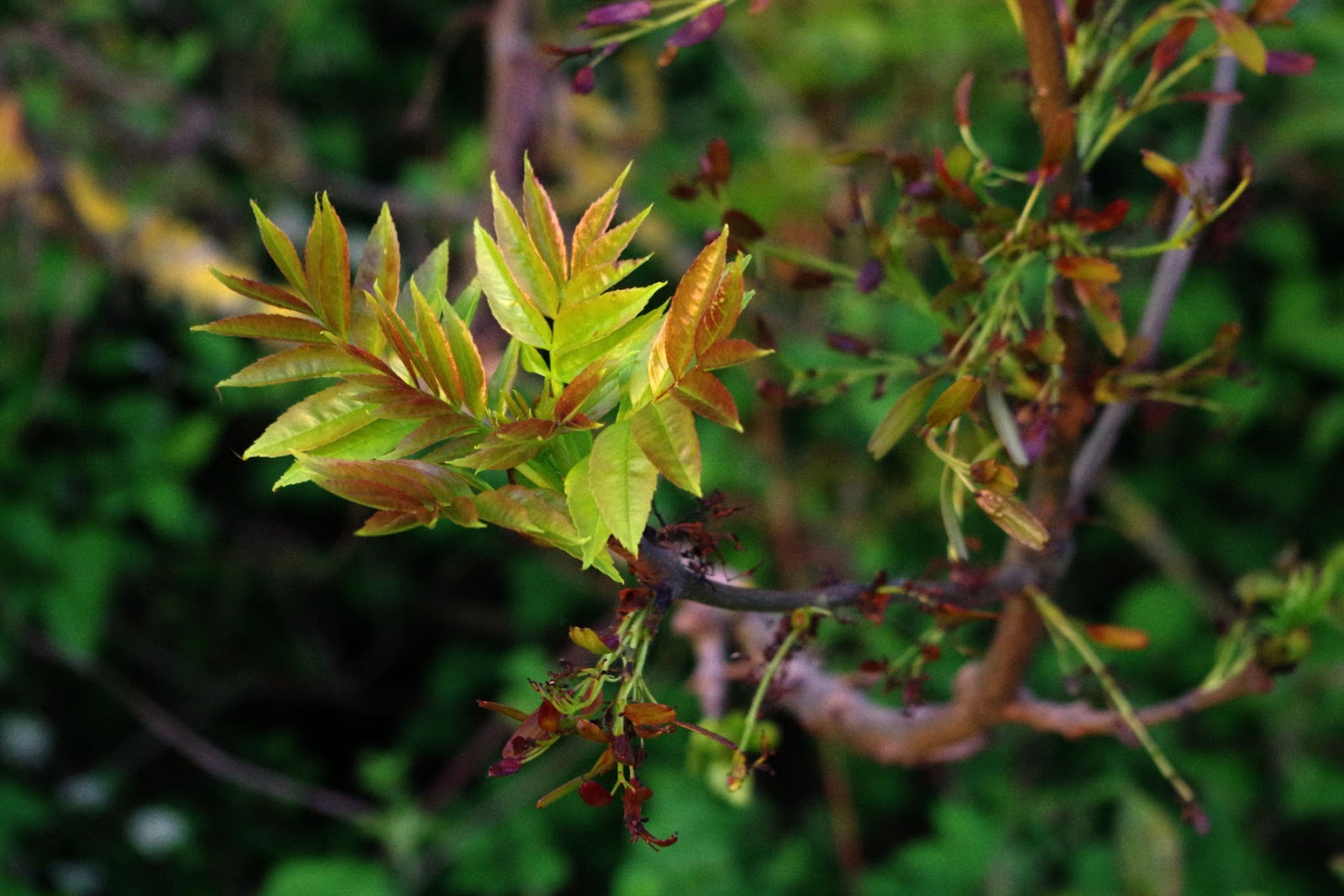
Young Ash leaves and tiny 'aeroplane' seeds.
The last rays of sun tured the young leaves of an Ash tree into a fiery bouquet.  Once dark had fallen, I visited the Trinity Park pond. I was thrilled to detect a bat at approximately 47 and to catch brief glimpses of it hunting over the pond.

Coot, May 17th.
Over the next couple of days, I returned to the pond, snatching a few minutes from the working day to watch the birds. 

Watercolour and ink sketch of Moorhen chicks, May 19th.
One lunchtime, squeaking attracted my attention. I saw 3 black fuzzy Moorhen chicks clambering and tumbling around in the reeds. I watched, amused by their antics. Tiny wings flapped as absurdly huge feet grasped strands of old reed.  They were soon joined by their parents who seemed to tell them off for straying so far and making so much noise.

 Other birds that I saw at the pond included:
  • 6 Mallards - 2 males, 1 female and her 3 ducklings
  • 5 Tufted ducks - 3 males and 2 females
  • 2 coots.
In such a controlled, urban, environment, you would imagine that it would be difficult for me to find the type of agricultural weeds that Edith describes in entry for the 26th of May:

"Walking through the fields today, I gathered the pretty little Yellow Heartsease, growing among the grass and clover ... "

Field pansy, May 19th.
In fact, I am more likely to find such them in the unregarded edges of a business park or supermarket car park than amongst a heavily cleaned and controlled modern field crop. I didn't find any Heartsease but I saw, for the first time in my life, a Field Pansy. It was growing on a bank of rubble between the road and a car park. The bank was smothered white Cress flowers, Scarlet Pimpernel and Forget-me-nots.

Cress and Scarlet Pimpernel, May 19th.

Saturday, 12 March 2016

I had to carry my cycle ...

Edith's entry for 10th March 1906 describes seeing birds with nesting materials and a variety of wildflowers. She was clearly very determined to find particular flowers and says:

I had to carry my cycle nearly a quarter of a mile down a steep, muddy fordrough set thick with thorns, with high banks on each side. On these sheltered banks I found numbers of small celandine blossom ...

If you were wondering, the Topographical and Land-Use Terms page of John Morris Jones' site, tells us that fordrough means farm track. I am in awe of this young woman who, encumbered by long skirts and carrying a heavy Edwardian bicycle down a rough muddy track, explored and found the flowers she was looking for. My little walks have been far easier. This week I stayed at the Crowne Plaza hotel from Tuesday the 8th to Thursday the 10th of March, which is at the edge of the Pendigo lake in the NEC complex.

Gorse and Traveller's Joy.
I didn't have to go far to find my first wildflowers. There is a Gorse bush, smothered in its own yellow flowers and the fluffy seedheads of Traveller's Joy (clematis) just outside the hotel.  The Traveller's Joy is particularly apt as it is a friendly and well-placed hotel. I found Colt's Foot flowers while walking round the South East edge of Pendigo lake. This was first thing in the morning on Wednesday the 9th of March, 110 years and 5 days after Edith recorded finding some while on "a long walk".
Coots near the Crowne Plaza.
Coming back to the hotel, I found a pair of cheeky Coots grazing the newly laid turf just outside, having taken over lawn mowing duties from the rabbits that were there the previous night.
Sky Walk - close to the site of the former Pendigo buildings.
In Edith's time, the area was already associated with the name Pendigo. However it was a cluster of buildings, presumably a farm, rather than the lake that is there today. The buildings were roughly where NEC hall 5 is now, just south of the Sky Walk. Hall 5 is one of the halls being used for Crufts this year.
While I was staying at the Crowne Plaza, the NEC was preparing for Crufts.
My Thursday morning walk to the office was enlivened by trails of dogs, from stumpy bulldogs to tiny Chihuahuas converging on the NEC. In 1906, when Edith wrote her diary, Crufts had been running for 15 years under Charles Cruft and was held in Islington. The best champion (the forerunner of Best in Show) was a Scotch Collie called Wishaw Leader. Both Crufts and Pendigo have come a long way since then.