In her entry for May the 16th, 1906, Edith noted that:
"Some of the Horse-Chestnut trees are a mass of white blossom".
 |
| Horse-chestnut flowers, May 15th - in the evening sun. |
 |
| Horse-chestnut leaves, May 15th. |
110 years later, I am staying in the Arden Hotel, which is surrounded by trees and bushes including both red and white Horse-Chestnut trees. Their scent drifts over me as I examine the strange, complicated blooms. In her diary for this time, Edith painted many tree flowers and I've paid special attention to them in this post.
 |
| Hawthorn, May 15th - late moring. |
 |
| Pine flowers, May 15th. |
Earlier, as I walked to work from the station, I found a variety of tree flowers including great swags of May (Hawthorn) and the odd but attractive flowers of Pine.
 |
| Male (brown) and female (green) Birch Catkins, May 19th. |
Later the same day, as I was looking at the trees near the hotel, 7 House Martins flew overhead. In the car park, I found birches with catkins and briefly played hide-and-seek with vivid green but camera shy Polydrusus Weevils.
 |
| Crab apple blossom, May 15th. |
Clouds of Crab Apple blossom floated above the car park as the setting sun made their delicate white petals glow.
 |
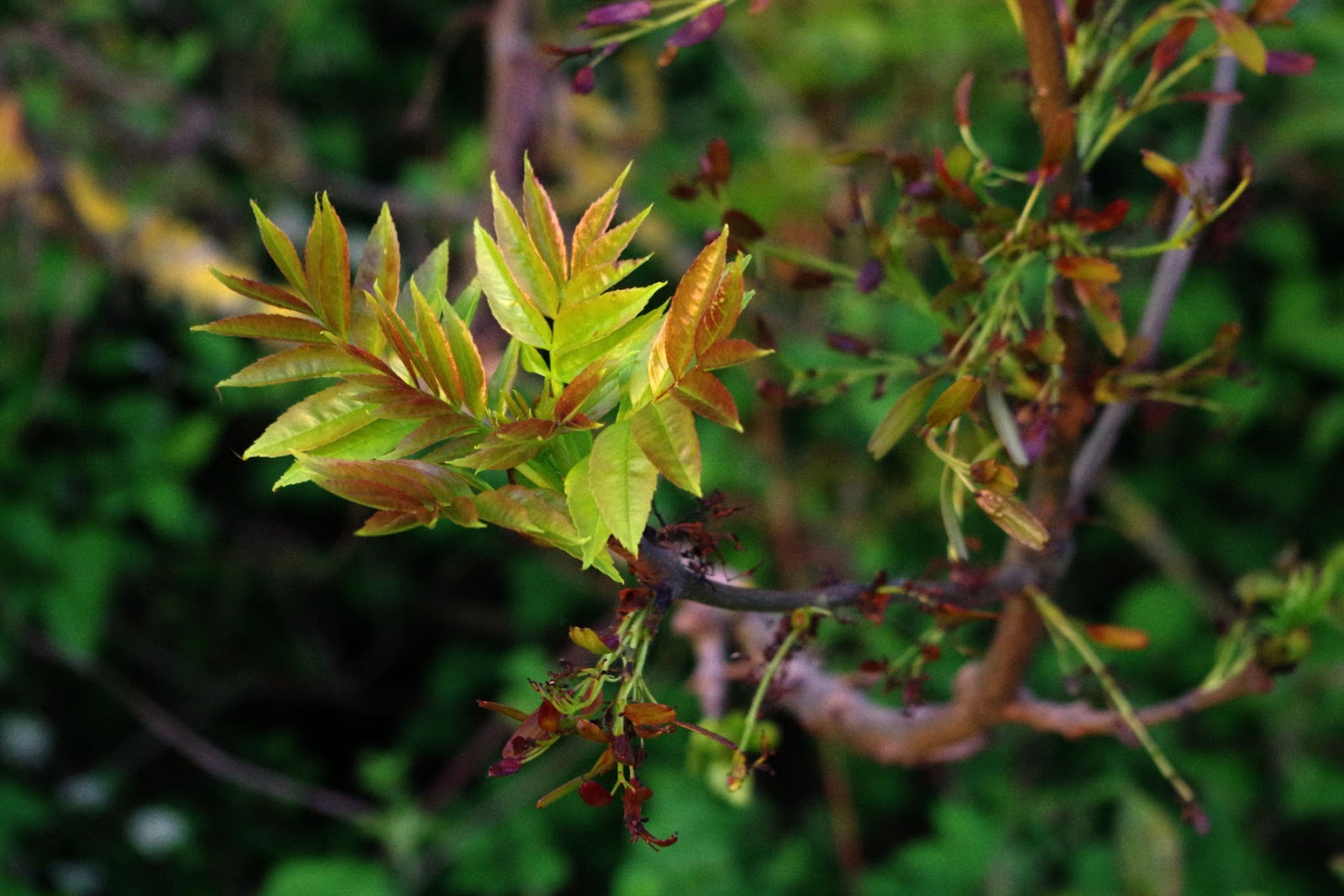
| Young Ash leaves and tiny 'aeroplane' seeds. |
The last rays of sun tured the young leaves of an Ash tree into a fiery bouquet. Once dark had fallen, I visited the Trinity Park pond. I was thrilled to detect a bat at approximately 47 and to catch brief glimpses of it hunting over the pond.
 |
| Coot, May 17th. |
Over the next couple of days, I returned to the pond, snatching a few minutes from the working day to watch the birds.
 |
| Watercolour and ink sketch of Moorhen chicks, May 19th. |
One lunchtime, squeaking attracted my attention. I saw 3 black fuzzy Moorhen chicks clambering and tumbling around in the reeds. I watched, amused by their antics. Tiny wings flapped as absurdly huge feet grasped strands of old reed. They were soon joined by their parents who seemed to tell them off for straying so far and making so much noise.
Other birds that I saw at the pond included:
- 6 Mallards - 2 males, 1 female and her 3 ducklings
- 5 Tufted ducks - 3 males and 2 females
- 2 coots.
In such a controlled, urban, environment, you would imagine that it would be difficult for me to find the type of agricultural weeds that Edith describes in entry for the 26th of May:
"Walking through the fields today, I gathered the pretty little Yellow Heartsease, growing among the grass and clover ... "
 |
| Field pansy, May 19th. |
In fact, I am more likely to find such them in the unregarded edges of a business park or supermarket car park than amongst a heavily cleaned and controlled modern field crop. I didn't find any Heartsease but I saw, for the first time in my life, a Field Pansy. It was growing on a bank of rubble between the road and a car park. The bank was smothered white Cress flowers, Scarlet Pimpernel and Forget-me-nots.
 |
| Cress and Scarlet Pimpernel, May 19th. |