Saturday, 9 April 2016

Fairy lamps and fresh spring leaves

From the beginning of April 1906, Edith noted the rapid advance of spring in her Diary. During my visit to Birmingham (5 to 7 April, 2016), I found several of the same signs of spring near the Arden hotel and NEC. She described what I know as pussy willow.

The "fairy lamps" of pussy willow.
"I went to a little spinney to see a large bush of Great Round-Leaved Willow, which is a perfect picture, just now, covered all over with great golden catkins that light up the copse like so hundreds of fairy lamps. The bees were humming all round it, busy gathering the pollen."

I was out too late in the day to see bees on the willow flowers but I did spot a couple of big buff-tailed bumble bee queens near the ground, perhaps returning to their nests.  In her entry for the 4th, Edith noted: "The sun has brought out the green leaf-buds on the trees and hedges very rapidly".  

Similarly in 2016, leaves are appearing on road and rail-side trees. In just a few minutes I found green leaves on field maple, sycamore, hawthorn, horse chestnut, elder, weeping willow and many others.

Young horse-chestnut leaves.
In her entry for the 9th, Edith described her journey to Stoke Bishop, on her way to Dartmoor and noted that "The low-lying fertile lands ... were golden with Marsh Marigolds".  I found a small clump of Marsh Marigolds at the edge of the Trinity Park pond.

A small clump of yellow marsh marigolds at the edge of the Trinity Park pond.
Early one morning, from an upstairs office window, a pair of Canada geese dipping together on the pond. They mated, spent a little time on a tiny island and then flew in a great arc round the pond, under my office window, then off in the direction of the NEC.
Canada geese at the Trinity Park pond.
I hope Edith's journey went more smoothly than mine to Birmingham. On Tuesday, overhead power lines had come down just North of Birmingham International. Having finally managed to board a train at London, everyone had to get off at Coventry. A colleague, who travelled earlier, spoke of considerable chaos but by the time I got there things had settled down. Coaches were taking passengers to Birmingham New Street and the few of us headed for Birmingham International were bundled into taxis.

Attending to the overhead wires.
While I was exploring that evening I saw trains moving through again and a group of men in high-vis clothes checking the overheads. In Edith's time, this sort of problem could not have occurred as there were few electric lines - just some in the South East, including the London Underground and the tiny Volks Electric Railway that still runs along Brighton sea front, not far from where I live.

Saturday, 2 April 2016

March is going out like a lamb

At the end of march, Edith's diary tells us that in 1906 ...

"A still grey day with beautifully dry roads. March is going out like a lamb." 

In 2016, on the 28th of March we were treated to storm Katie. The month ended with clear, bright days and cold nights.

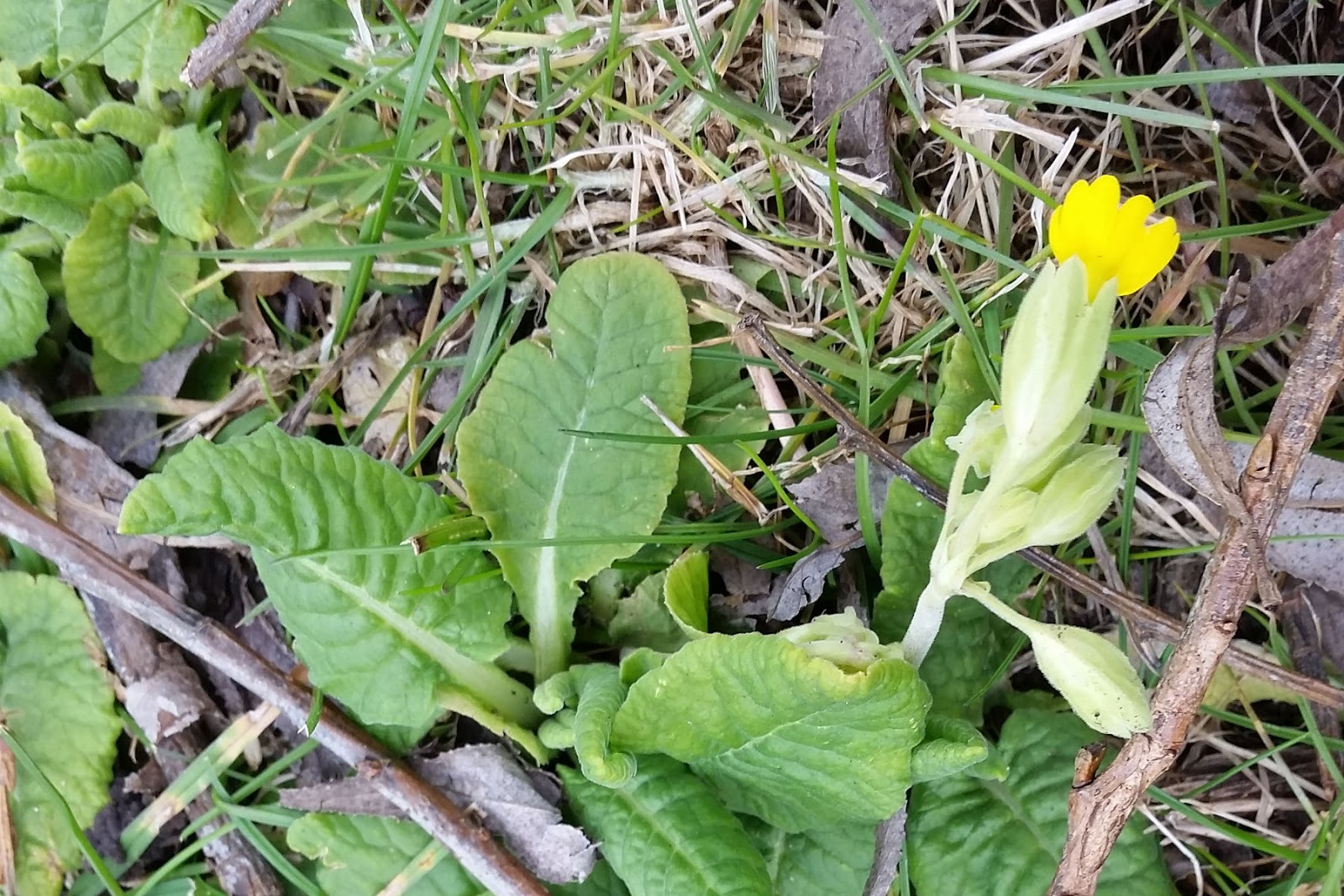
On March the 31st, the weather was fine enough for Edith to cycle out and look for wildflowers. She mentions primroses, sweet violets and dog violets and says that "the cowslips are only in bud yet". Edith goes on to describe the birds and nests that she found.  In 2016 Birmingham, the cowslips are just beginning to flower.

Cowslip near Birmingham International Station, March 22nd.
I haven't been to Birmingham this week but last week I saw some flowers and birds near the station and later near the hotel. Walking from Birmingham International Station to the Office, I saw cowslips, a Blackbird, a Bluetit and, most surprisingly of all, a Song Thrush.

While staying at the Airport Holiday Inn, I did a little exploring.  First thing in the morning I investigated the verges the the huge roads just outside the hotel. Outside the Travel Lodge, which is next to the Holiday Inn, last year's grasses and seedheads are masking a green carpet studded with vivid blue Green Alkanet flowers.

Green Alkanet by the side of the Coventry Road
Oddly, a spash of orange announces a stray garden marigold.

A stray garden marigold
Crossing the road I find the curious combination of a glossy car dealer and the shabby-looking buildings of the former Village Farm.

Village Farm
Further on, I follow a tattered bank of trees and bushes round the corner into the Damson Parkway, which is a major route to the Land Rover factory, Solihull and beyond.  A hawthorn hedge and a grass bank with trees and daffodils separates fields from the heaving traffic.

Forget-me-not at the foot of a hawthorn hedge, Damson Parkway
After finding Forget-Me-Nots and glossy leaves of Lords-and-Ladies I hurry back to the hotel for breakfast and the bus to work.

In the evening, I venture out again. This time down the Old Damson Lane. Here there is a Rugby Club, a promising footpath and the nicely-kept Dunstan Farm.

Primroses at Dunstan Farm
After a few minutes, the old lane rejoins the Damson Parkway. A new entrance and wood chip surface tempts me along the first section of  a footpath to Bickenhill.

Solihull footpath.
I can see the church spire across the fields and the first leaves of bluebells but the light is fading and I reluctantly return to the road. I hope to come back to these footpaths - Solihull Council are doing a good job with them here. The footpath skirts the Northern edge of the new dispatch centre for the Jaguar Land Rover. I wait for a shipment of vehicles to leave before crossing its entrance.

Vehicles leaving Jaguar Land Rover dispatch centre.
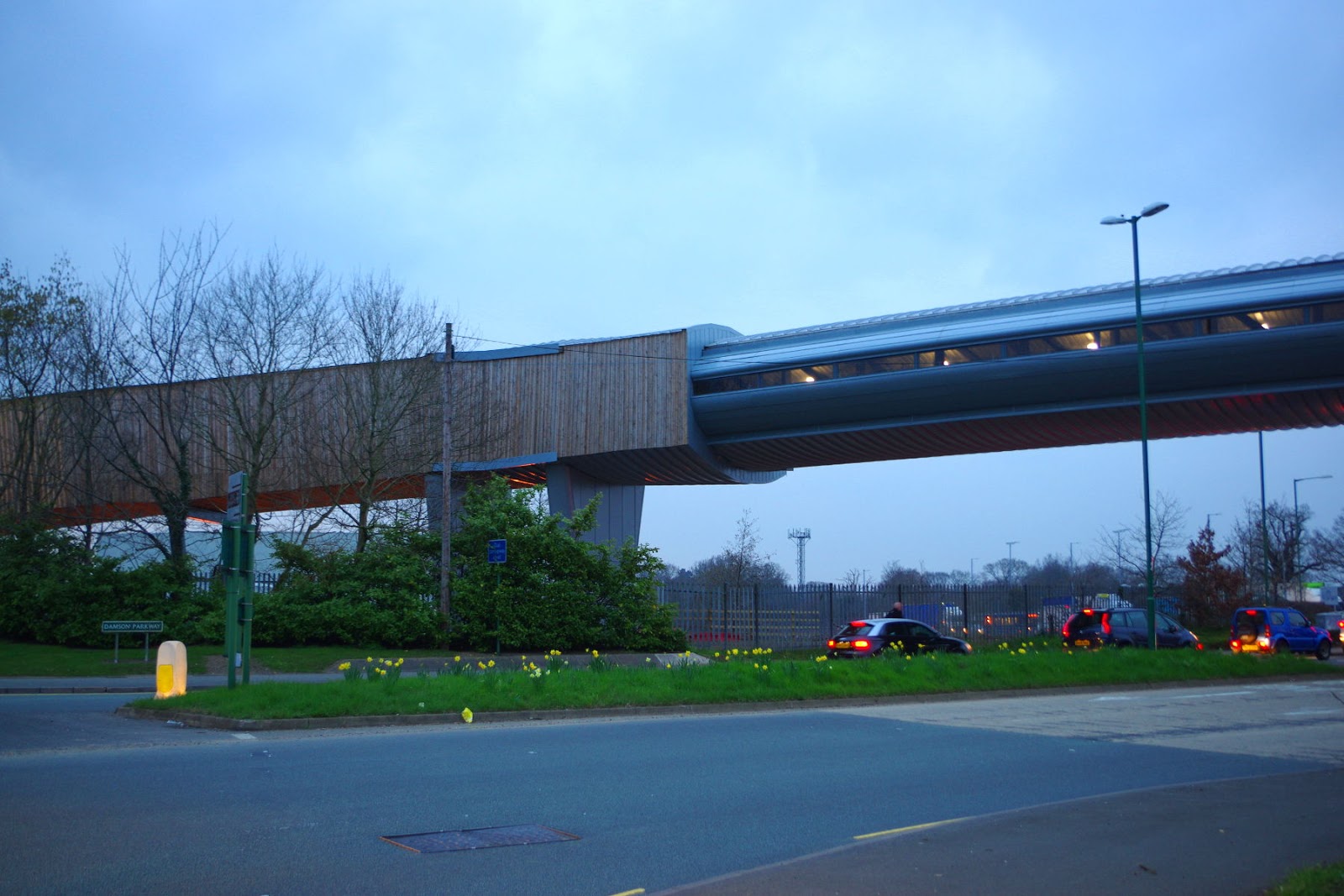
A modern tubular bridge links this with the factory site.
Bridge linking Jaguar Land Rover factory with dispatch centre.

Blackthorn blossom near the bridge.
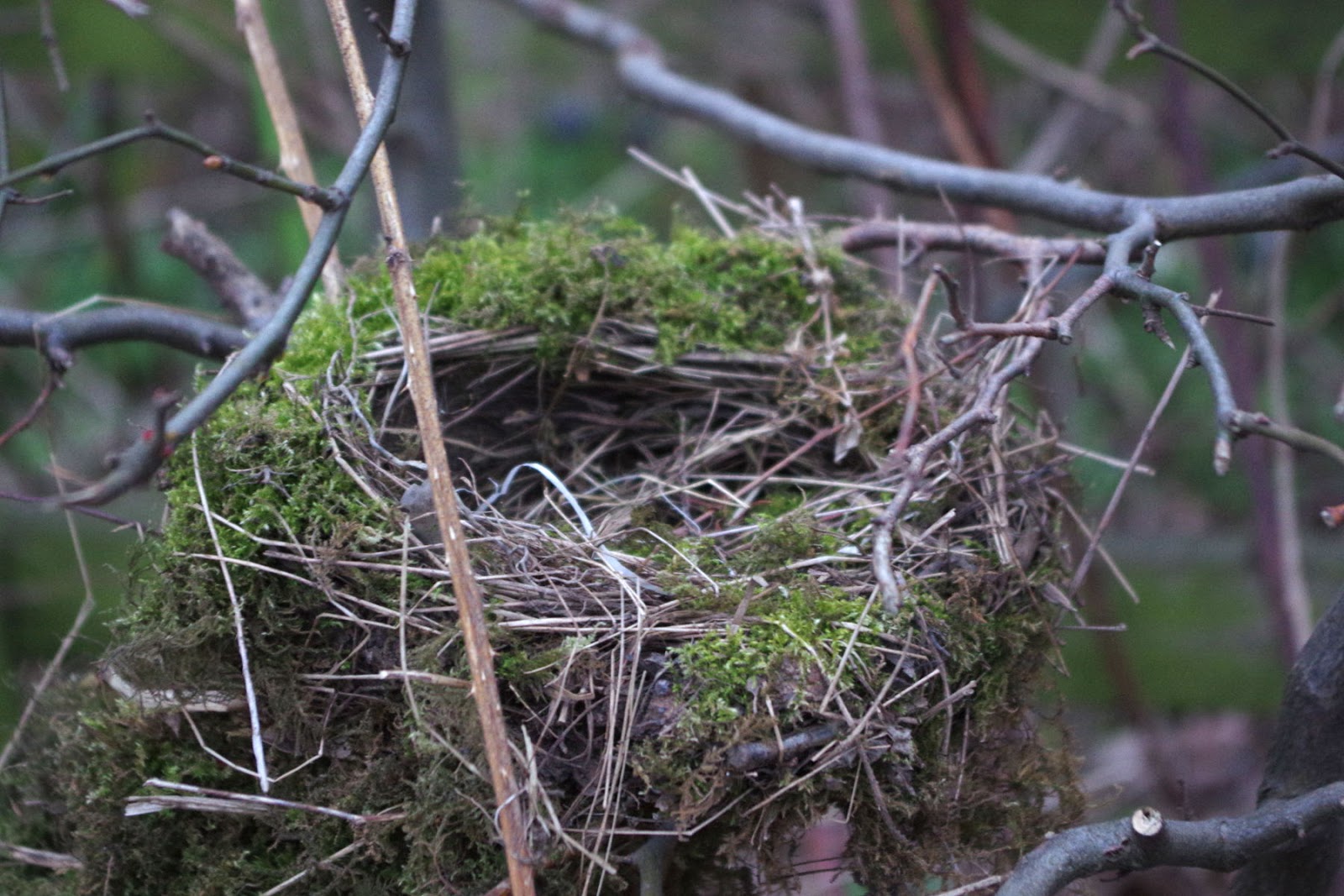
It seems impossible that wildlife could thrive amongst the thunder of traffic and bustle of factories but a hedge along the side of the road has clearly been a home to a nesting bird. I love the way that the moss that last year's parent bird used to make a neat cup has grown and merged with the hedge.
Nest in the hedge by the Jaguar Land Rover factory.
So while the area is much more built up and noisier than in Edith's day, wildlife is still finding spaces in which to live.

Sunday, 27 March 2016

Your flight is delayed until 1909

This week I've been staying at the Holiday Inn hotel near Birmingham International airport. The airport is at Elmdon, which was one of the places where Edith used to walk and make her observations for her Country Diary of an Edwardian Lady.

The Birmingham Airport Holiday Inn.
In September 1909, just 3 years after Edith wrote her famous diary, Alfred P Maxfield flew the first aeroplane in the Birmingham area. The History of Castle Bromwich for Young People site has a photo of this plane and explains the history of the aerodrome that was to develop there. It tells us about:
  • the early, hair-raising, fun days of flight
  • the serious business of WWI when the aerodrome developed to accommodate war planes and trainee pilots
  • the development of commercial flights in the early thirties
  • the move of non-military flights to Elmdon (now Birmingham International) airport just a few years later.
The old terminal - now used as offices.
The photo shows the original, 1939, terminal. It looks a little forlorn now as the passengers now leave from the big, new terminals on the North side of the airport. Here's a video from the glory days.


Britsh Pathé news - The opening of the airport in 1939 (advert at start)

The visitors to the hotel are a friendly bunch. On the shuttle bus (to the station/airport) and in the restaurant, there was much talk about the new Emirates Airbus A380. The Birmingham Mail tells us that it is starting regular trips to Dubai from today, Easter Sunday, 2016.

I could tell you about this huge plane but far better to watch @DMTaylor90's amazing video of it coming into Birmingham.

@DMTaylor90's video of the New Emirates Airbus coming into Birmingham.

A footnote ...
On 3rd February 2017, the Holiday Inn Birmingham published a post that said
"Originally built as the Headquarters for the RAF, the Holiday Inn Birmingham Airport is celebrating it's 80th year."

https://www.facebook.com/HIBhamairhotel/photos/a.1539738669598377.1073741836.1517099785195599/1829746453930929/?type=3&theater

Sunday, 20 March 2016

Went to the daffodil field again

In her entry for the 20th of March, Edith says:

Went to the Daffodil field again; The buds are just breaking into yellow. Found two Thrush's nests both in holly bushes, one nest was empty, the bird was sitting on the other, she looked at me with such brave, bright eyes, I could not disturb her, much as I would liked a peep at her speckled blue eggs.

Rabbits in the NEC's daffodils.
When I was in Birmingham, from the 8th to the 10th of March, there were certainly plenty of daffodils in full bloom. While walking through the NEC grounds one night, a colleague spotted some rabbits amongst the bright yellow blooms.

I find myself wondering what sort of daffodil field she meant. Maybe it belonged to a commercial grower. The first show for the Midland Daffodil Society (now the Daffodil Society) was held in the Botanical Gardens, Edgbaston, Birmingham 1899. The programme, available from the Northern Group's website tells us that a number of commercial growers from the area were exhibiting:
  • Simpson and Son, Birmingham
  • Hewitt and Co, Solihull
  • John Pope, Birmingham
  • Robert Sydenham, Birmingham
In her diary, Edith mentions visits to Packwood in February and July. Ragged Robin's splendid blog describes both Edith's and her own visits. Ragged Robin's post shows Packwood's lovely, naturalised daffodils. However, if Edith Packwood, I'm sure she would have mentioned it.  
Wild daffodils and other spring flowers from my Sussex garden.
I think that it's most likely that Edith's daffodil field contained the wild species. She certainly painted some on a nearby page. The Warwickshire Wildlife Trust runs the Harvest Hill Nature Reserve, which "is one of the last remaining wild daffodil meadows in the area." That tantalising "remaining" suggests there would have been more in Edith's time. 

Daffodils under an illuminated tree, Birmingham NEC.
I'm sure Edith never saw daffodils and trees lit up like this! The lights run through a cycle of red, blue, green and magenta. I find them strangely compelling to watch although I suspect any nesting birds will go elsewhere.

Resort World - there are bird boxes in the dark area to the right.
However there are bird boxes nearby, close to the Resort World hotel and, last year, I saw young Great Crested Grebes so even though I didn't see any nesting birds, they are sure to be around somewhere.

Saturday, 12 March 2016

I had to carry my cycle ...

Edith's entry for 10th March 1906 describes seeing birds with nesting materials and a variety of wildflowers. She was clearly very determined to find particular flowers and says:

I had to carry my cycle nearly a quarter of a mile down a steep, muddy fordrough set thick with thorns, with high banks on each side. On these sheltered banks I found numbers of small celandine blossom ...

If you were wondering, the Topographical and Land-Use Terms page of John Morris Jones' site, tells us that fordrough means farm track. I am in awe of this young woman who, encumbered by long skirts and carrying a heavy Edwardian bicycle down a rough muddy track, explored and found the flowers she was looking for. My little walks have been far easier. This week I stayed at the Crowne Plaza hotel from Tuesday the 8th to Thursday the 10th of March, which is at the edge of the Pendigo lake in the NEC complex.

Gorse and Traveller's Joy.
I didn't have to go far to find my first wildflowers. There is a Gorse bush, smothered in its own yellow flowers and the fluffy seedheads of Traveller's Joy (clematis) just outside the hotel.  The Traveller's Joy is particularly apt as it is a friendly and well-placed hotel. I found Colt's Foot flowers while walking round the South East edge of Pendigo lake. This was first thing in the morning on Wednesday the 9th of March, 110 years and 5 days after Edith recorded finding some while on "a long walk".
Coots near the Crowne Plaza.
Coming back to the hotel, I found a pair of cheeky Coots grazing the newly laid turf just outside, having taken over lawn mowing duties from the rabbits that were there the previous night.
Sky Walk - close to the site of the former Pendigo buildings.
In Edith's time, the area was already associated with the name Pendigo. However it was a cluster of buildings, presumably a farm, rather than the lake that is there today. The buildings were roughly where NEC hall 5 is now, just south of the Sky Walk. Hall 5 is one of the halls being used for Crufts this year.
While I was staying at the Crowne Plaza, the NEC was preparing for Crufts.
My Thursday morning walk to the office was enlivened by trails of dogs, from stumpy bulldogs to tiny Chihuahuas converging on the NEC. In 1906, when Edith wrote her diary, Crufts had been running for 15 years under Charles Cruft and was held in Islington. The best champion (the forerunner of Best in Show) was a Scotch Collie called Wishaw Leader. Both Crufts and Pendigo have come a long way since then.


Monday, 29 February 2016

The Edwardian Lady and Birmingham New Street

Edith Holden is famous for her Country Diary of an Edwardian Lady, written in 1906.  However she also had a successful career as an artist and illustrator.  Her biography, by Ina Taylor, says:

In art particularly the town was well served with galleries at the Royal Birmingham Society of Artists [RBSA] where the two exhibitions every year attracted great interest. A museum was established, and there was also the Municipal Art School, which had a reputation for being the best art school outside London.

Edith entered the art school at 13, having already shown a talent for sketching. While at the school, she won prizes.  When she completed her basic training, she specialized in animal paintings.

When she was 19 one of her paintings was accepted for the RBSA Autumn Exhibition. From 1890 to 1907 she regularly exhibited at the RBSA.  Wikipedia tells us that, at this time, the gallery stood behind a neo-classical portico in New Street. It says: Increasing financial pressure in the early years of the 20th century led to the society's landmark New Street building being demolished and rebuilt as part of a commercial redevelopment.

The RBSA website says:  In April 2000, after being based at New Street in Birmingham since 1829, the Royal Birmingham Society of Artists relocated to a new gallery just off St Paul’s Square.

New Street's Grand Central station - work continues on the roads outside.
When Edith was exhibiting her paintings in New Street, there was already a fine, Victorian station. The New Street, New Start web site tells us: The station was badly damaged by bombing raids in World War ll leading to the removal of the roof after the war.  The original station was finally demolished in 1964. The station that replaced it has just been superseded by the new "Grand Central" station. I've travelled through there several times as I am working just a few stops down the line , near Birmingham international.

Thursday, 4 February 2016

It says in today's Chronicle ...

In her "Country Diary of an Edwardian Lady" entry for February the 3rd, Edith Holden states:

It says in today's Chronicle that at Dover a Blackbird's nest with two eggs have been found at Edenbridge, a Hedge-sparrow's with four eggs and at Elmstead, a robin's with five eggs.

The beginning of 2016 too has been extremely mild. Although, like Edith, I read about unseasonable animal behaviour in the newspaper, I got much more immediate information through BBC Winterwatch and Twitter, especially Winterwatch's #WeirdWinter theme.  All sorts of people reported untimely wildlife behaviour including January swallow sightings and young grebes on the Thames. Earlier in the month, I was one of hundreds people who took part in the BSBI's New Year's Plant Hunt and (in Sussex) found Hawthorn and Cowslips in flower - both of these should be out in May.

January cowslip (Sussex)
While I was looking for flowers, my mobile phone and Twitter enabled me to share photos with many of my fellow plant hunters, instantly.  Back in 1906, Edith, her friends and neighbours would have shared information via face-to-face conversations, letters and parcels. Telephones were available but calls were costly. So while she could write down her observations in a diary and provide illustrations for magazines, it would be 70 years before her diary got the audience it deserved.

Easy mass communication has made crowd-sourced citizen science projects commonplace. Over the last weekend of January, the RSPB ran the #BigGardenBirdWatch. About half-a-million people count the birds that land in their gardens over the course of one hour. The RSPB then collects all this information and compares it to previous years.    As well as doing my own bird count, in Sussex, I have been able to follow others' sightings via Twitter. 

My #BigGardenBirdWatch notes (Sussex)
I think that, as someone with a keen interest in nature, Edith would have enjoyed taking part in the #BigGardenBirdwatch. As a teacher, she wrote her diary as a model for her pupils to follow. Perhaps if she were living and working today, she would  have followed the RSPB's advice to devote a lesson to observing the birds.