Sunday, 22 May 2016

Horse-Chestnut Trees are a mass of white blossom

In her entry for May the 16th, 1906, Edith noted that:

"Some of the Horse-Chestnut trees are a mass of white blossom". 

Horse-chestnut flowers, May 15th - in the evening sun.
Horse-chestnut leaves, May 15th.
110 years later, I am staying in the Arden Hotel, which is surrounded by trees and bushes including both red and white Horse-Chestnut trees. Their scent drifts over me as I examine the strange, complicated blooms. In her diary for this time, Edith painted many tree flowers and I've paid special attention to them in this post.

Hawthorn, May 15th - late moring.
Pine flowers, May 15th.
Earlier, as I walked to work from the station, I found a variety of tree flowers including great swags of May (Hawthorn) and the odd but attractive flowers of Pine.

Male (brown) and female (green) Birch Catkins, May 19th.
Later the same day, as I was looking at the trees near the hotel, 7 House Martins flew overhead. In the car park, I found birches with catkins and briefly played hide-and-seek with vivid green but camera shy Polydrusus Weevils.

Crab apple blossom, May 15th.
Clouds of Crab Apple blossom floated above the car park as the setting sun made their delicate white petals glow.

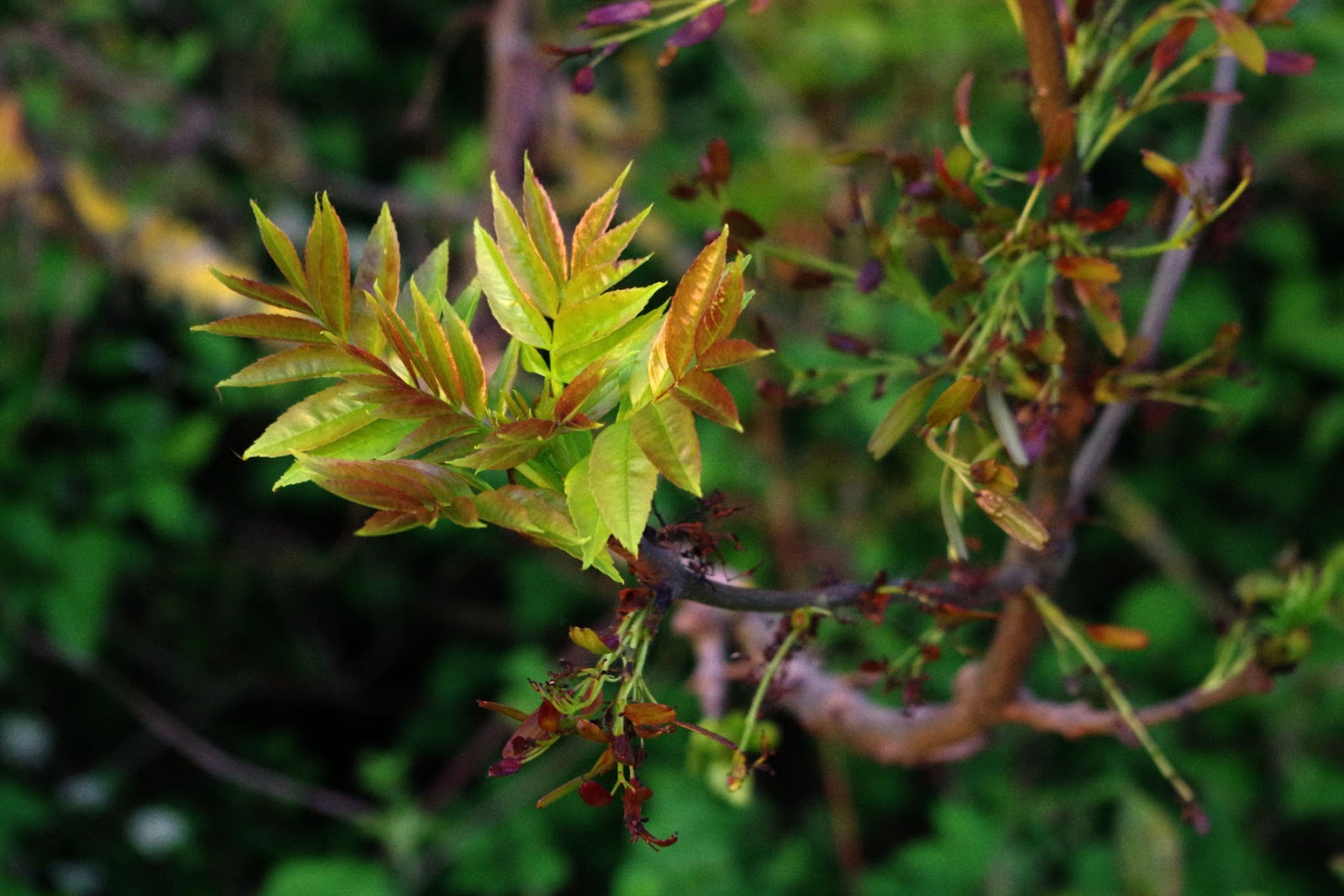
Young Ash leaves and tiny 'aeroplane' seeds.
The last rays of sun tured the young leaves of an Ash tree into a fiery bouquet.  Once dark had fallen, I visited the Trinity Park pond. I was thrilled to detect a bat at approximately 47 and to catch brief glimpses of it hunting over the pond.

Coot, May 17th.
Over the next couple of days, I returned to the pond, snatching a few minutes from the working day to watch the birds. 

Watercolour and ink sketch of Moorhen chicks, May 19th.
One lunchtime, squeaking attracted my attention. I saw 3 black fuzzy Moorhen chicks clambering and tumbling around in the reeds. I watched, amused by their antics. Tiny wings flapped as absurdly huge feet grasped strands of old reed.  They were soon joined by their parents who seemed to tell them off for straying so far and making so much noise.

 Other birds that I saw at the pond included:
  • 6 Mallards - 2 males, 1 female and her 3 ducklings
  • 5 Tufted ducks - 3 males and 2 females
  • 2 coots.
In such a controlled, urban, environment, you would imagine that it would be difficult for me to find the type of agricultural weeds that Edith describes in entry for the 26th of May:

"Walking through the fields today, I gathered the pretty little Yellow Heartsease, growing among the grass and clover ... "

Field pansy, May 19th.
In fact, I am more likely to find such them in the unregarded edges of a business park or supermarket car park than amongst a heavily cleaned and controlled modern field crop. I didn't find any Heartsease but I saw, for the first time in my life, a Field Pansy. It was growing on a bank of rubble between the road and a car park. The bank was smothered white Cress flowers, Scarlet Pimpernel and Forget-me-nots.

Cress and Scarlet Pimpernel, May 19th.

Saturday, 14 May 2016

A Bat Hunt at Birmingham NEC

After exploring the Bluebell wood and walking round the Birmingham NEC, I had a quick meal at the Crowne Plaza and then came out again in the hope of finding some bats.  The Bat Conservation Trust tells us that "Bat use high frequency calls normally beyond the range of human hearing to build up a sound picture of their surroundings. This echolocation system enables them to wing their way through the dark night hunting the tiniest of insects." I had a "heterodyne" bat detector with me, which makes these calls audible to my much less sensitive human ears. 

View of Pendigo lake from the Crowne Plaza - early morning.
The photo, taken from my hotel room gives an idea of the layout of the area.  The Resorts World hotel and outlet is on the immediate left and the big red building seen to the North of the lake is one of the NEC halls. The trees to the immediate right of the red building are the woodland that I explored earlier in the evening.  The path you can see in the foreground leads round the edge of the lake.

Pendigo lake from the South end of Pendigo lake - about 9pm.
At about 9pm, about half-an-hour after sunset I left the hotel. I turned right and followed the path round the South end of the lake. I had set the bat detector to 45, which is the frequency that our most common bat, the common pipistrelle uses to echo locate its prey in the dark.  While walking, I held the detector up and swept it round. Just a few metres from the hotel I heard some clicks coming from one of the trees at the lake edge. I couldn't see anything and swung round. There were louder clicks coming from a group of trees on a grassy bank between the lake and the car park. As I watched, I could see two and then three bats dancing in the air.

View of Resort World from the South end of the lake - 9:20pm.
They left the trees and flew in the direction of the lake. I watched for a moment then walked to the end of the lake-side path. From here I took nearly an hour to follow the path anti-clockwise round the lake, ending up at the entrance to the wood I had explored earlier.  I detected hunting bats nearly all the way round. The only gaps were in front of the Resort World hotel and the shingle beach at the North West end of the lake. The absence of bats in front of Resort World fits in Bristol University's web page, which tells us:

"Warren et al. (2000) found that when foraging over water, common pipistrelles prefer areas of smooth water surface with trees on both banks. These areas were found to be abundant in flying insects and low in acoustic noise."

Resort World from the North end of the lake - about 10pm.
Just before the end of my walk I encountered two young men who wanted to know what I had in my hand. I explained about the bats and pointed the detector over the lake so they could hear it click. They were exited to hear the bats and told me about the wildlife near their own homes - one had owls nearby and the other had foxes that visited his garden.

Wednesday evening

Sun dipping below the horizon - approx. 8:30pm.
This time I wanted to find out when the bats emerged so, before the sun set, I waited by the trees where they seemed to gather on the previous night. The sun set at approximately 8:30pm and I waited about half-an-hour for the bats to appear.

View from the South end - 8:45 pm
9:04pm - First clicks. One bat appeared and flew round the trees  for about 5 minutes before disappearing over the bank separating the lake from the car parks. A few minutes later it returned.

9:17pm - Second bat appeared and joined the first.

9:22pm - They were joined by a third and then all three went hunting over the lake.The bats are not the only ones hunting the insects that fly over the lake. Every minute or so I hear a plop and see rings spreading out over the water - presumably from hungry fish.

Great-Crested Grebe - 9:09 pm.
Birds were still active too. In the time that I was waiting, a heron flew over the lake into the woodland on the East side. A Great-Crested Grebe glided past and I decided to leave the dark lake to the creatures of the night.

Sunday, 8 May 2016

Oaks showing their first signs of golden bronze

In her entry for the first of May 1906, Edith wrote about her journey home from a holiday.

The country is looking much more beautiful than when I came through it three weeks ago. The primroses are still thick on the banks, the hedge are all green, many of the apple orchards in blossom; and the Oaks showing the first signs of golden, bronze foliage.

Fields between Coventry and Birmingham.
On my way from Sussex to Birmingham I saw many primroses tumbling down shaded banks and, between Coventry and Birmingham saw a countryside that was, in many ways, not so different to the one that Edith saw - with fields separated by hedges, farm houses etc. However, Edith would not have seen so many yellow rapeseed fields on her journey. The crop has increased massively from the 1970s when scientists bred varieties suitable for human consumption. Increased mechanisation means that there are fewer people and no horses working the land.

This week I was lucky with my hotel room. I've been staying in the Crowne Plaza and had a room looking over the NEC's Pendigo lake. In search of oak trees, I headed to the North East part of the lake, near the Hilton Metropole hotel, where there is a bluebell wood.

First sight of the woodland from the lakeside - Oak with fresh leaves.
Skirting round the edge of the lake, a quick glance reveals that the Oaks here are already green with new leaves.
Bluebells and Yellow Archangel.
 
A path leads me through a patch of bluebells mixed with Yellow Archangel, which Edith referred to as Yellow Weasel's Snout. Two Carder bees are visiting the flowers.

Looking up at a big oak, just coming into leaf.
The oak that I saw from across the water is a lovely big tree that makes a fine silhouette against the sky. As I look up, a group of ducks fly over.  A red-tailed bumble bee is bumbling around the flowers and foliage at its feet.

Fresh Oak leaves and tassels of Oak flowers
As I follow the trail, a younger tree has branches low enough for me to take a good look at the tassel flowers. 

A view of Resorts World from the woodland.
There is a tremendous amount of bird song in this wood.  A sudden rustle attracts my attention and I see a squirrel running up a tree.

oak apples.
Further along, a large tree has oak apples, which are the homes of a tiny gall wasp.  Although the wood is heavily used by hotel guests, there are many wild plants and the promise of flowers to come. Wild Arum is sending up spears, and there are large clumps of foxglove and honeysuckle leaves.

Bluebells near the Hilton Metropole.
If I pick my view carefully, I can see just a lovely sweep of bluebells and trees.

Looking towards NEC halls.
Finally the big NEC halls come back into view and I continue my walk.

Huge Oak - 3 hugs!
The bluebells gradually thin out. Just before the end of the green area, just beyond the hotel, there is a huge, ancient oak. It would take three people to get their arms round it.  I wonder just how many years it has been there and am thankful that the NEC developers had the sense to work round this irreplaceable giant.  When Edith walked and cycled round the countryside, it is quite likely that she passed this already mature tree.

Friday, 29 April 2016

Birmingham's City Centre Garden

Edith's diary for this week describes the flowers and birds she found in the last week of her 1906 Dartmoor holiday. She travelled back on the first of May.

Last week, I described my walk along part of the Birmingham and Fazeley Canal. After I had left the pub, I headed as directly as possible towards the Library. 

City Centre Gardens - just behind the library.
Concious that my walk hadn't been much of a nature ramble, I was delighted to find the City Centre Gardens tucked between the library and the huge blocks of flats I had seen from the canal.  

White Japanese Cherry blossom - from outside the garden.
The library peeping out from behind the Japanese cherry blossom.
It was dark and I couldn't see much. but there was a spectacular row of White Japanese Cherries.  I was tempted to explore there and then but I heard two men arguing in the garden and thought better of it. As I went to photograph the cherry blossom, I encountered one of the many rough sleepers in the city. We exchanged a few words and I gave him a couple of coins. 

Thinking about the less fortunate residents of the city, Ina Taylor's biography of Edith Holden describes the family's work with the poor children of Birmingham. Edith's father, Arthur, was involved with Birmingham's Labour Church who were involved with the Cinderella Club. This organisation organised treats and outings for the children.

The next morning, I spent some time looking out of the window of my 16th floor hotel room - it was a little strange to look down on Herring Gulls wheeling over the city rooftops.

Pink cherry blossom and the BT Tower.
On the way to the station, I returned to the garden for a better look.  Tucked between large buildings, it really has the feel of a secret garden with plenty of blossom trees and flowers.  The surrounding buildings made for some interesting views.

Colourful flowerbeds below looming buildings.
It was early so I had the garden to myself. Walking through, I spotted two Blackbirds, a Woodpigeon, two Robins, a pair of Bluetits and, surprisingly, a pair of Mistle Thrushes.  These are a bit bigger and greyer than a Song Thrush. They acted as described in Cocker and Mabey's Birds Britannica:

On the ground it is far more unapproachable and maintains a bold, alert stance or moves in a series of long vigorous bounding hops.

Delicate pink cherry blossom in front of the bold patterns on the library.
As I was leaving the park, the homeless man seemed to be dozing, his back to the wall of the building next to the park.  I paused to watch the Bluetits go in and out of Japanese cherry blossom, then gathered a few fallen blossoms. When I turned, he was smiling at my slightly absurd antics - I grinned back, greeted him and went on my way.

Sunday, 24 April 2016

Birmingham and Fazeley Canal

On the 19th of April 1904, Edith was still on her Dartmoor holiday and her diary entry describes a visit to the pretty river Walkham. On that day in 2016, my stay in central Birmingham took me to a more urban waterway. I've previously visited the Gas Street Basin on the New Main Line.

The Malt House on the New Main Line.
This time I followed the New Main Line as far as the Malt House. Last year, I visited this pub on a cold winter's evening and enjoyed fish and chips and was warmed by an open fire while listening to a jazz ensemble. In Edith's time, this building was probably still used for its original purpose of malting grain for beer making. At this point, I crossed the New Main Line so I could follow the older Birmingham & Fazeley Canal. While I was crossing the bridge, a group of ducks glided past.


View along the Birmingham and Fazeley Canal.
The Canal and River Trust web site tells us that this canal opened in 1789. Once hemmed in by works and wharfs it now drops down between modern apartments and lively bars. 

Cambrian Wharf area.
The canal is well-kept by the Canal and River Trust (West Midlands) who are running the #sharethespace campaign in which canal and towpath users are asked to be considerate.

Be like the duck and not the goose - #sharethespace
Looking across the canal, I can see three large blocks of flats. Beyond that is the new library.  From the bridge, I was able to look down a flight of locks.

Flight of locks
A Canal and River Trust notice tells us:

The Farmers Bridge Lock Flight is one of the most unusual sights on Birmingham's canal network. The canal plunges down 81 feet (25 metres) through dramatically floodlit archways, office undercrofts, and claustrophobic tunnels.

There are numerous slopes and I puzzled over ridges of raised bricks - the bricks were clearly replacements for the originals but this feature had been retained in the restoration.. In the end, I figured out that these helped the horses that pulled the narrow boats grip the tow path in wet weather. 

Modern Bridge.
About 6 locks down the flight, I found an unusual bridge.

Stepping back.
Taking in a wider angled view, enabled me to see the BT Tower.

Dropping underground.
After this the walk became a little spookier. The canal dropped into the understory of a large building and came out between high walls. There was no longer the sense of safety provided by the people overlooking the canal from homes and bars. The walk ways became shabbier but more intriguing. More of the brickwork was original here and the ridges that I had noticed in the restored part were now smoothed down by thousands of feet and hooves.  After the 12th lock, I was sufficiently spooked to scurry up a flight of metal steps to the surface.

I was trying to figure out where I was when I spotted the library. A number of the Herring Gulls that haunt the city were wheeling round the "cliff faces" provided by the library and other large buildings nearby.
The Shakespeare, Summer Row.
As I walked towards the library, I found The Shakespeare pub. After seeing so many modern and often rowdy and intimidating bars, it was refreshing to find a traditional, friendly pub.  It was arranged with the bar in the centre, a lively area at the front, a quiet area behind the bar and a garden at the back. I had an excellent meal of Devonshire crab followed British beef pie for a remarkably modest price. The website tells us that this pub ...

"... is where the goldsmiths and silversmiths from the nearby Jewellery Quarter once quenched their thirsts. In the mid-19th century."
The Shakespeare, showing its fine arched windows.

By the time I had finished my meal, it was getting dark and I returned to the hotel - I cut across behind the library and made a surprising and delightful discovery but more of that next time.

Sunday, 17 April 2016

World made up of sky and gorse

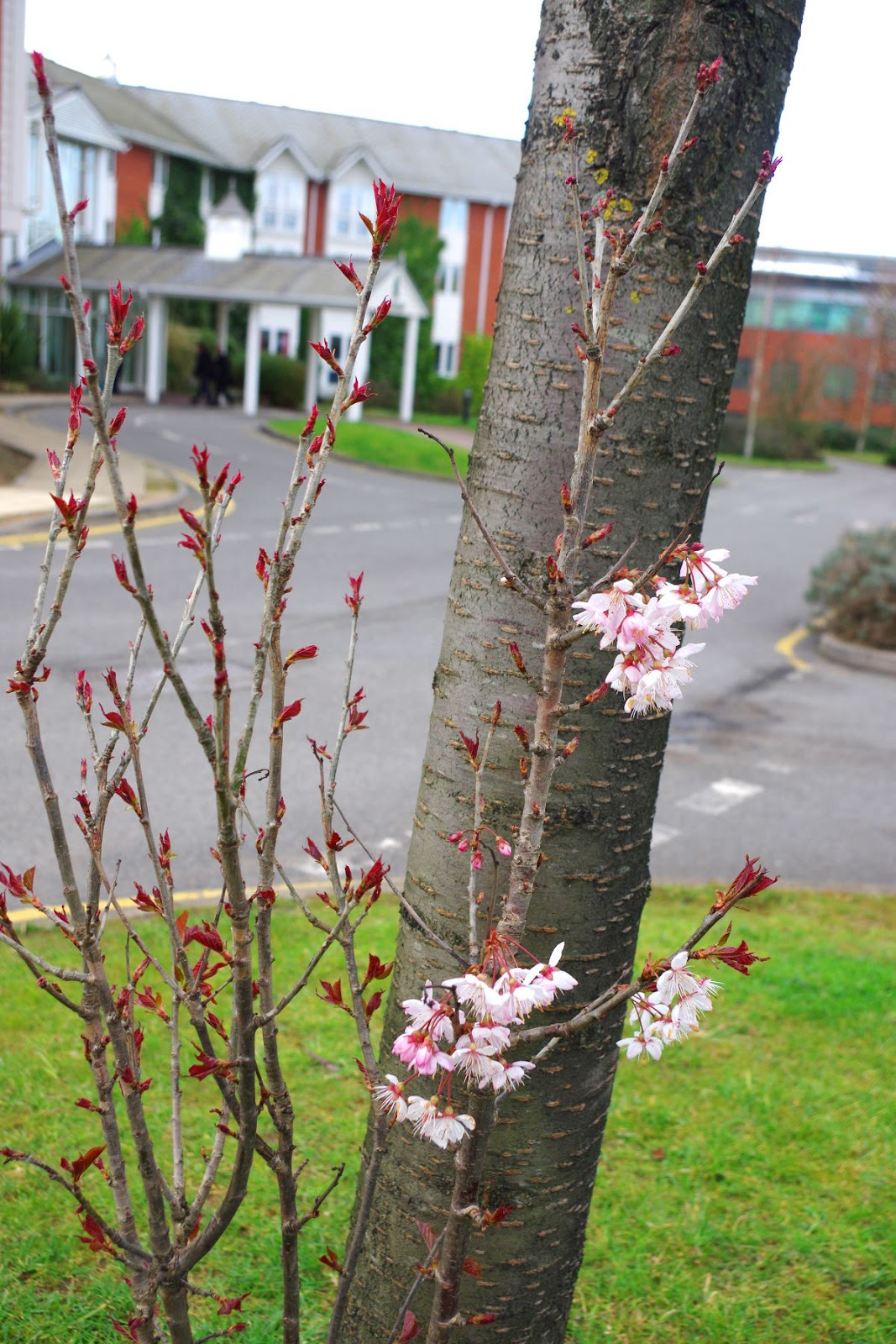
When I took my walk near the Arden Hotel and Birmingham NEC on the 5th of April, I was in search of blossom. This was because, in her entries for the 7th and 9th of April, Edith had mentioned seeing blackthorn, Damson and Plum. I started well, spotting some stray twigs with early blooms at the foot of a tree in the hotel car park.

Cherry blossom outside the Arden.
However, the huge trees between the A45 and the Birmingham NEC were not yet in flower. Luvkily there were other flowers to see. On 11th of April, 1906 Edith wrote about her time in Dartmoor:

Up on the moor the world seemed to be made up of sky and gorse - such acres of golden blossoms under a sky of cloudless blue.
Gorse, the great survivor, by the A45
I saw gorse too, although it was enlivening the side of the A45 under a leaden sky. Just round the corner, a great river of gold cascaded down a bank to one of the NEC car parks. I followed the bank round and cut across a road on my way to Pendigo lake.
Advertising for Comic Con
A quick walk through a grassy area with trees took me to the lakeside. 
My sketch of a cormorant - Pendigo lake, NEC
I perched on a seat in front of the Resort World hotel and watched the birds.  I saw 5 Canada Geese, a coot, 2 moorhen, 2 black-headed gulls and a cormorant, which obligingly sat on a post while I drew it.  Sketch finished, I noticed a cloud of white blossom near the lake side and hurried towards it.
Great-crested Grebe  - Pendigo lake, NEC
As I scurried along the lakeside path, an indignant flurry of feathers shot out from almost under my feet.  I had startled a Great Crested Grebe.
Puffs of blossom - NEC
Once I reached the tree, and looked up, I found it it had lovely puffs of blossom on a tracery of branches silhouetted against the now clear blue sky.  
Blackthorn blossom - Station Link Road.
On my way back to the hotel, a froth of blackthorn seemed to echo the clouds overhead. Just 10 days later I read, in the Birmingham Mail, that it has been snowing in Birmingham. I hope that the blossom isn't spoilt.